Working with the outlined publishing models, identify the various roles you (and potentially others) will be undertaking for assignment five. For example, you’re likely to be writing your own content, designing your book, editing and reviewing it. You may also be involved in the production, printing and distribution process. Consider each aspect of the book assignment and briefly list what roles you think you’ll be doing, and what these roles entail. Also make notes of the roles of others who might be involved in your assignment and what their contribution is.
Roles
The traditional model for publishing is:
Writer – Publisher – Editor – Designer – Production – Printer – Distribution – Retail
However there are other models depending on the type of book to be produced; the scale at which it is produced; the cost; and who commissioned it etc.. Below are some more non-traditional publishing models:
Publisher – Writer – Editor – Designer – Production – Printer – Distribution – Retail
Editor – Publisher – Writer – Designer – Production – Printer – Distribution – Retail
Illustrator/Designer/Photographer – Writer –Publisher – Editor – Production – Printer – Distribution – Retail
Responsibilities
Assignment 5 would be most suited to a hybrid approach of the first and last examples where writer/illustrator/designer/photographer would be the starting point as it would be me creating most of the content for the book.
I again looked at Andrew Haslam’s Book design, where I knew there was a list of the different roles that could be involved in publishing a book. I wanted to see which were pertinent to what I was going to create for Assignment 5.
Author/Writer: This would be me and would consist of writing the brief for the chosen subject; researching and writing the content.
Agents: Not needed at this stage.
Publisher: As the book isn’t being sold, I won’t need a publisher.
Book Packager: This is mostly my role again as I will be the one creating the overall book except for production. Marketing would also be part of a book packager’s role.
Commissioning Editor: This role would not be needed as such, but I would be choosing which book to produce for the final design.
Editor: I would be responsible for editing the book with some input from my peers.
Proofreader: I would also be proofreader for the book, but may enlist someone else to double check my checking!
Consultant: This role is not needed. However, the book is supposed to be about something I know, so you could say I will be my own consultant.
Reader: This role would need to be someone impartial with a knowledge of the chosen subject. I suppose this would be my tutor of fellow designers.
Art Director: This role would be filled by myself with input from my peers.
Designer: As above.
Picture Researcher: This again would be myself and I would have to source suitable imagery for the book and check on any licensing that may be needed.
Permissions Manager: This role would be for me to sort out if any text or imagery used needs any specific permissions or fees paid.
Image-makers: Illustrator/photographer/cartographer: This again would be down to me in the case of this assignment. But external contractors could be used.
Rights Manager: Not needed for this assignment but would be needed if contracts etc. were required between different members of the publishing process.
Print Buyer/Production Manager: This role would be done by myself in this case, especially when it comes to production of a physical book with costings and liaising with printers etc..
Printer: The printer would most likely be an external company which would need to be researched and a relationship cultivated with to achieve the best results when producing the book.
Print Finisher: This would also be done in-house at the printers as this is a specialist role, unless the book is to be hand-finished.
Binder: As above
Distribution Manager: This role will not be needed for a job of this type unless it went into full production.
Sales Representative: As above.
Retailer: As above. However there is scope for a small run being sold independently.
Having printed your images from the previous exercise, take the opportunity to view all of the pages, reflect on them and evaluate before moving on to the next step of collating and binding the pages together. Which pages are successful? Which pages have not turned out as well as you had hoped? Are there any visual surprises, or happy accidents? Given the experimental and open-ended nature of this exercise, the answers may be quite subjective, but it is important you reflect on these and other questions, to sharpen your self-critical awareness and assessment of your own progress.
You may want to re-work some of the images, and the printing process, and this is your opportunity to do that. You may end up with more and more pieces of printed paper.
Select and collate
Evaluate the strengths and weaknesses in your work and then begin a process of selecting up to 16 pages that work well together as a whole. Do these pages have images on each side of the page, or will the images appear on facing pages only? If you want to create back-to-back images you can work manually to cut and paste images and pages, using spray mount or similar. Equally, you can collage elements of printed ephemera onto and into the pages. Again, the brief is to be experimental, so work inventively with the process, cutting, gluing, pasting and arranging as you see fit. Collate these pages, putting them into a running order from beginning to end.
Binding
Drawing on your understanding of bookbinding so far, bind your 16 pages into a small book format. How will the pages be held together? Consider how the pages might be bound and experiment with solutions. Will you create a cover? Will the pages be stitched, sewn, glued, stapled or will you use another inventive approach?
There are many ways to bind a book, either by hand or by machine. A few examples of bookbinding are saddle stitch, Japanese binding, coptic binding or perfect binding. Consider which binding is most appropriate for your book. There are some good tutorials online of bookbinding and this might be useful for you to have a look at. Try to use one of the bookbinding techniques mentioned above for your own book.
Document the whole process, photograph the book and incorporate them into your learning log, accompanied by supporting work, including pages and images you chose not to include into the final book form.
Reflection on my images
I was happy with my final imagery for the last exercise. If I could say that I had a least favourite it would be the image of the woman and the bridge. This was one of the first images I did and it seems very simplistic compared to the others, however it did convey it’s message very well.
My personal favourite was the cows and oranges which is a slightly surreal nod to the poem and also adds some humour to the overall design. How that would be viewed at the time the poem was written is a different matter. To me the poem seems very serious and solemn with little room for humour.
The idea of using the bird’s squeal and writing it in the Cyrillic alphabet worked well and gave an essence of authenticity to the piece as well as a nod to the propaganda of the communist state.
I had somehow jumped ahead in the last exercise and displayed my images as a concertina-fold publication with the images on both sides in a non-linear format. I had also had them printed out to scale by a company called Printspace but they could only do them single sided. I thought that maybe I could stick the 2 sides together to form the booklet but wasn’t sure whether it would work. I decided to give it more thought.
My prints from Printspace
Binding
As I’d already imagined my design as a concertina-fold publication I wanted to replicate this as ‘proper’ book.
I began researching how hardback books were made and watched several YouTube videos on how to make a book cover. One in particular was very useful:
This was purely about making the cover for a pre-made text block and was very easy to follow and I felt I could replicate something similar.
I began by cutting out the board which would make the book’s cover.
For the cover of the book IO used some of the GF Smith paper that I had collected. I wanted to give the effect of a concrete texture on the paper(as this was a Concrete Poem) and picked a be-speckled paper called Gmund Bier that is made using the waste material from the brewing process which gives it its texture and feel. On this paper I printed my piece from the Concrete Poetry exercise to use as my cover.
I then lined this with more GF Smith paper, this time a scarlet colonnade paper from their Colorplan range. I was pretty chuffed at the result at this stage, not bad for a first attempt!
I then concertina-folded my printed images to stick into the cover. I had decided to keep them separate and attach on to each side of the cover and then they could fold out when the book was opened.
I was relatively happy with the result, but if I were to do this again I would think about lining the reverse side of the pages, maybe with the scarlet paper in a lighter weight, and possibly some form of band or fastener for the two sets of pages as they didn’t open easily as two separate sets of pages.
I thought that this style of book wasn’t really bound. I decided to try something else. I divided my images into individuals and thought about stitching them together, but the images didn’t have enough of a border on which to stitch them. This then led me to have a go a perfect binding as this wouldn’t impede on the imagery. I went back to Youtube and found a tutorial on DIY prefect binding:
I thought I’d give it a go and began by gluing my images together.
I applied 3 coats of glue in all to bind the edges of my images together. Once dry I added some of the scarlet paper which I would then use to attach the pages to the inside of the cover. I made another cover, smaller this time to fit the contents better, which I finished in the same way as the previous version and stuck the perfect bound images into it by attaching the red papers to the insides of the cover.
This was more of a traditional way of displaying the images but it had worked better than I’d anticipated. It was an interesting process which on the whole was a success. On reflection the cover for this could’ve been a little larger as there wasn’t much room top and bottom inside the book.
Reflection
This was an interesting exercise that made me think more about how books are constructed and the things to bear in mind when putting books together such as margins, what type of binding to use and how the book would be read. This exercise has given me a lot more to think about when continuing to design books in the future and I hope to use some of the lessons I’ve learned here going forward.
In this exercise you’re going to create images which you’ll then print onto the papers you collected in the first exercise. You have been working with the poem Tango With Cows in the exercise ‘Concrete Poetry’, to create an experimental text. Using your interpretation of the poem as a starting point, develop a set of images that you can sequence into a narrative. You can choose to create these images yourself or use existing images.
Idea generation
Create a series of images which will build a narrative sequence over about 16 pages.
Use keywords from the poem as a starting point. Work with images you have created before, developing and changing their contents, or use fresh new ideas and imagery related to the poem. Remind yourself of the creative design process.
Explore the sequential narrative over the folds. Produce a folding document (2 sided) with the images you have created. Try one of the folding systems discussed in part two of the course, Form and Function: Paper folding.
Research and development
A visual narrative is a way of communicating some form of ‘story’. It may be that you interpret ‘narrative’ in a conventional way, using chronological images of how your identity has changed over time, with a beginning, middle and an end. Or perhaps you’ll work in a less obvious way, exploring how your images can be exploited through abstraction and print processes, using the term ‘narrative’ as a vehicle on which to hang your concept of the poem.
The purpose is to interpret the brief to create images that are meaningful to you, plus extend your understanding of image qualities. These images may be paintings, photographs, drawings, film stills – they can be at any scale, in any media and about whatever you want them to be, in the context of exploring the concept of the poem. This is your opportunity to explore some of the features of digital imaging software, such as Photoshop, to layer images, cut out images, experiment with opacity, filters, hue, brightness, contrast and halftone screens, among other things.
For example, can we approach text as image? What happens if you ‘rasterize’ text, then begin to manipulate it, in the same way as you would montage image material. Be creative! Explore!
Remember you have access to Bridgeman and Oxford art libraries online also, if you want to download images and work in this way, but originating your own images will make the project more personal to you.
Design
For this exercise I started by picking out a few of the key phrases from the poem.
I ended up with picking out 10 hey phrases that stood out. I had some ideas for some of the phrases but others needed some work.
The first phrase that I had an idea for was “Or better still – we’ll get a record player. Well, to hell with you!”. The idea was to have a vinyl record being engulfed in the flames of Hell.
This was achieved by layering different sized images of flames in front and behind the record which colour was altered to reflect the colours of the flames. I also desaturated some of the flames to give the impression of smoke. I was happy with the resulting image and thought it was a good starting point. Upon returning to the poem and re-reading it, it occurred to me that the punctuation of the poem meant that it the part about the record player and the flames of Hell were two separate parts and didn’t relate to one another directly. So I went back to the drawing board.
I moved on to the phrase “Perhaps we’ll drink a glass of wine to the health of comets”. I couldn’t quite get my initial idea of a comet in a glass of wine right. I decided to simplify the idea and used an image of a raised glass desaturated and cut out placed on top of a saturated image of a comet streaking across the sky. I also tried multiple raised glasses of different scales and angles but this didn’t work as well as the single glass. I liked the way the cutout glass sat on the colour image, there was something Terry Gilliam about the image.
I was happy with this and moved on to my next image. “kings of orange groves and cattle” was an image I toyed with for a while. Which was the dominant word in the phrase? What needed emphasising the most? I couldn’t decide, but I knew that orange would be the dominant colour in this particular image. I tried looking for images of orange groves that would inspire me but couldn’t find anything. I then came across an image of just some oranges…
I had the comedic idea a to insert cows in between the oranges wearing crowns, a little surreal I know!
This made me and my peers laugh, so that decided it…it was in.
The next phrase was “…and to build bridges from the tears of bovine jealousy to the tears of crimson girls”. I decided to split this phrase into 2, the crimson girls and the bovine tears. I started with the ‘crimson girls’ half of the phrase and used an image of a tearful woman which I desaturated and overlaid a crimson red filter. I then used an image of a bridge which I laid over the top and used a gradient to mask some of the image so that the crimson woman showed through.
The next phrase was the easiest to put into pictures. “With tinned mirth…” was an obvious one and just required some type manipulation and the addition of some highlights to make make it look more realistic.
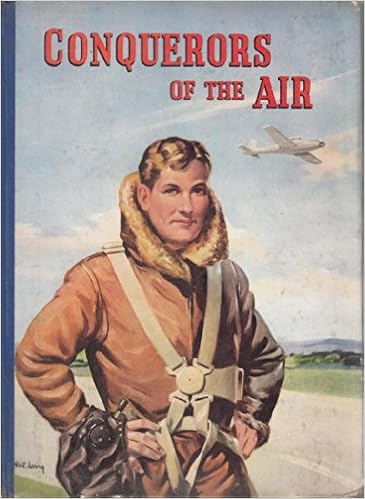
Next was “…conquerors of the air…”. There is a book called Conquerors of the Air by Harry Harper.
This made me think of the Communist propaganda posters showing off their supremacy. I started with the type and used a font called DDC Hardware from Aaron Draplin which has a utilitarian look and feel. I replaced the Q of the word conquerors with the hammer and sickle and stacked the type. I set the type on top of a communist propaganda poster displaying air power which I overlaid with a red filter. I still wasn’t happy with the design so I added another layer on top which was the blueprints of the Russian MIG-25 aircraft and added a paper texture to make it look like a poster.
I was really starting to enjoy this form of creating imagery from a piece of text.
The phrase “Well, to hell with you! hornless and ironed!” lead me to rethink my original ‘record player hell’ due to misinterpreting the punctuation. The ‘hornless and ironed’ part of the phrase conjured up the image of a cowhide rug. I found an image of a cowhide being tanned. This coupled with an image of some lava gives a dramatic and interesting result.
Next up was the first line of the poem, “Life is shorter than the squeal of a sparrow”. I had the idea of giving this the look of some of the propaganda posters I had seen, a call to arms. I used a desaturated image of a sparrow and added geometric lines and shapes to make it look as the sparrow was ‘squealing’. Rather than using the actual word squeal, I translated the word into the Cyrillic alphabet to give it more of a Russian feel and a nod to the poem’s origins.
I thought that this would make a very good and powerful cover for the book.
7 down, 3 to go. I decided to return to the record player line, this time without the fires of hell! Again I wanted to give it a propaganda look, but this time a little more modern. Using black and white imagery of a retro record player and a strong geometric background I gave it more of a retro look by changing the whites to a faded cream colour. This gave it a softer look but there was still too much whitespace. I then added one of the cows from the ‘oranges’ image which gave it a more quirky look but worked very well. There was still too much space around the image so I added the description of a record player from Google Dictionary in the DDC font I used earlier.
Onto the other half of the phrase “…and to build bridges from the tears of bovine jealousy”. For this image I didn’t want it to be in the same style of the other half of the phrase. I started with the colour green as this was associated with jealousy. I used an image of a bridge with the water underneath substituted with a green overlay. I then needed a crying cow which I gave green overlaid tears. this somehow didn’t look right until I added a green circle in the centre of the image, over the cow’s eyes.
I couldn’t finish the series of images without visualising the tile of the poem which is also used in the line “I want one – to dance one tango with cows…”. I began with an image of some ballroom dancers which I substituted the heads with those of cows. I then placed these into and image of some farmland and a barn. The image of the dancers seemed quite traditional in nature as opposed to the modernist nature of the poem. I decided to embrace the contrast and used a filter to give the image a more classical painted look.
Now I had my images. I wanted to put it on a concertina-fold book with 5 images on each side. I just had to decide the order in which they appeared. Do they need to be in linear order or would a more disjointed approach work?
I drew a flat-plan to help me envisage what order the images needed to be on the book.
This was harder than I thought and took a while to get my head around. I knew which images would be my front and back covers, but getting them in the right sequence needed thinking about to make sure when the book was folded they would be in the correct positions. As for the rest of the images, I decided to randomise the order as I thought that they could be treated as individual images as well as one poem.
It took me a while to get into this exercise, it stumped me for a while. But once I had found a starting point the creative juices began to flow. It also gave me a chance to re-familiarise myself with Photoshop which I hadn’t used for a while. I enjoyed manipulating and layering the images and also injecting some humour into the imagery. I feel that I have given the poem a modern twist while using the imagery to nod to its communist/modernist roots.
To begin: Collect a wide variety of paper samples and other paper ephemera across a range of weights, textures and surface finishes. This builds on your previous paper sample exercise from Part Two. Aim to collect a wide range of unprinted papers, such as blotting paper, tracing paper, lined paper, graph paper, rice paper and handmade papers. Look out for papers with special print finishes – metallic, embossed, shiny and matt. Aim to collect paper that is light as a feather and heavier, more dense, paper. Collect papers that will run through a conventional desktop printer, or indeed the print output options you have available to you – this may include board.
In addition, collect paper ephemera that you find interesting or that appeals to you in some way. This may include tickets, flyers and similar printed material or mementos or souvenirs of exhibitions, occasions and days out. Create a stack of these papers for use in your next few exercises.
In your learning log, document some of these papers and their attributes. Use a reflective approach and simple, descriptive words. For example, it may be that a heavy, coarse coloured paper reminds you of primary school, or the particular smell and shine of a paper puts you in mind of glossy magazines, or the fish and chip shop. Document these associations, however bizarre, into your learning log and/or ongoing paper sample book – you may revisit the words and phrases you use here later on in this process.
New Samples!
This doorstop of a tome is my new favourite thing. After seeing this on social media I had to hunt it down and finally got my hands on it. This is 449 pages of paper loveliness in weights from 90 – 1400gsm and in an amazing range of colours, textures and finishes. It contains papers from mills all around the world including Germany and Japan which are perfect bound together to produce this monumental resource.
I also was invited onto a webinar for the launch this new sample range which was very informative and went into great detail about the origins of the papers, the manufacturing process and the ethics behind the sustainability of the production process of some of the papers. It also covered the process of making the sample book itself including how the thumb-dividers, which divide the sections, were all cut by hand.
hand-cut thumb-dividers
I also ordered some samples from G F Smith to get a better idea of some of the tactile qualities of the paper.
Living in a house with young children means that we are never short of various types of crafting materials including paper along with the usual suspects.
Tissue Paper
We probably have every colour under the sun of tissue paper in the house. This particular type of paper reminds me of primary school, screwing up balls of tissue to stick to some creation or other. It also conjures up the smell of PVA glue. This could be printed on by hand as the nature of the paper makes it very delicate to mechanically printed.
Corrugated Paper
This was also in the ‘craft box’. It’s more of a corrugated paper rather than a card. It is very tactile and quite course, I think it was used as packaging for some wine glasses from New York so it reminds me of our time there. It would be possible to print on to this, but again I think it may need to be hand printed.
Dotted Paper
This is the interior of my sketchbook. I have recently switched to using it and I like the combination of the freedom and rigidity the dotted layout gives you. It isn’t the smoothest paper and is slightly transparent, which can be useful for tracing.
Lined Pad
We have several of these in the house and they are used for notes, shopping lists and general day-to-day use. The paper is quite opaque and very robust and will happily handle a biro or a marker pen. It would also easily fit through a desktop printer. It reminds me of the pads that we used to use to write the bottling-up list on at the end of the night when working in a pub. This one is my wife’s from when she worked at the Guardian, not one from a bar in Torquay!
Black(ish) paper
This paper feels cheap and nasty. It’s the type of paper that was used to mount your schoolwork on. It’s thin and rough to touch, but I’m sure would run through a printer. However, it would be tricky to print a decent image on it due to its dark colour.
Kraft Paper
We have a huge roll of this. It gets used for drawing on and as environmentally friendly wrapping paper. It reminds me of how we used to write specials in a restaurant I worked in. We had a huge roll on the wall which we would write every day with a big Sharpie marker and reminds me of that smell. This could easily be printed on, but I’m not sure how the ink would take as it has a slightly glossy finish.
Mounting board
This was what I used to mount my work for submission fro Core Concepts. It is very thick and has a shiny side and a matt side. It is too thick to go through a printer but could be hand printed or pressed.
Cromatico Digital
Cromatico Digital is the first pure white translucent paper designed specifically for all HP Indigo digital presses and dry toner technologies. Available in three weights, it is widely used by some of the world’s most respected luxury brands. Each sheet incorporates a silver strip at each end that activates the photoelectric cells when the paper is fed onto press. It can be folded, scored, embossed, foiled, varnished and die-stamped.
This feels very silky to touch and has a luxurious feel. It has a matt texture
Gmund Blocker
Gmund Lakepaper Blocker offers a new level in opacity for paper. Complete opacity has previously meant using heavy paper weights but as the name suggests, Blocker uses unique ingredients with special ‘blocking’ additions in the paper making process to create fine lightweight sheets with maximum opacity. Blocker is perfectly suited for jobs where high ink coverage and minimum show-through is required.
This is 80gsm in weight and is almost completely opaque. It has a high quality feel and is very smooth to touch. It reminds me of very high quality book pages with a matt finish.
Takeo Pachica
Takeo Pachica is one of the most technically advanced papers in the world. Brought exclusively from Japan to the UK by G . F Smith, it has a luxurious tactility. It also has a hidden special property; by debossing an area of the paper with a heated die, the impressed area becomes transparent.
This is a very special paper that feels like fabric and when it is debossed as described above it gives an amazing finish that is very unique and looks very high-end.
Ephemera
Besides all the samples I have from printers I have a large collection of menus, tickets and rugby paraphernalia. This ranges from tickets with multiple finishes on them such as varnishes and foiling to full-colour glossy programs to laminated passes. I have menus and table-talkers from various places I have worked with varying levels of finishes.
Once you start looking around you start to notice the types of paper, the different finishes and printing techniques and appreciate what has gone in to producing it.
Concrete poetry, sometimes referred to as visual poetry, is a form of experimental typography where the use of letter and word arrangements enhance the meaning of a poem. The typographic treatment of words within concrete poetry starts to add additional resonances through their scale, placement, overlay and styling, suggesting new ways to see and say the poem. Early examples of concrete poetry were by artists such as Kurt Schwitters and Vasily Kamensky. The development of experimental typography flourished during the 1950s and 1960s with artists such as Dom Sylvester Houédard, Ian Hamilton Finlay and Carl André. Often letterpress and the typewriter were used for experimental typography during this period.
“Inspired by the pioneering work of Mallarmé, Apollinaire, the ‘zaum’ poets, Futurism, Dada, and drawing on the more recent example of Lettrism, the central focus of Concrete Poetry was on the written word as a visual phenomenon. Typography was therefore a central concern, with letterform, weight, scale and page layout all contributing to the meaning of the work.”
Simon Morley, Writing on the wall: word and image in modern art, 2003. London: Thames & Hudson.
“Generally speaking the material of the concrete poem is language: words reduced to their elements of letters (to see) syllables (to hear). Some concrete poets stay with whole words. Others find fragments of letters or individual speech sounds more suited to their needs. The essential is reduced language. The degree of reduction varies from poet to poet, from poem to poem.”
Mary Ellen Solt, Concrete Poetry: A World View, 1968. Indiana University Press.
Critical writing task
Identify an example of concrete poetry and write a short critique of the content, design and the relationship between the content and form. How has the use of typography, layout, and space been employed to help generate meaning? Print out a copy of the poem and add notes directly onto the page. Write a brief summary of your thoughts, feelings and reflections on how concrete poetry creates new meanings.
As a starting point you may want to look at the following artists who practiced Concrete Poetry:
● Dieter Roth ● Max Bense ● Eugen Gomringer ● Ian Hamilton Finlay ● Henri Chopin ● Öyvind Fahlström ● Emmett Williams ● Geraldine Monk ● Mary Ellen Solt ● Ilse Garnier
To explore concrete poetry in more depth you may want to read Mary Ellen Solt’s 1968 Concrete Poetry: A World View, available via UBU: http://www.ubu.com/papers/solt/ Or research the work of individual visual poets at UBU: http://www.ubu.com/vp/
Visual task
Use one typeface to create a playful design for the Tango with Cows, 1914, by Russian Futurist Vasily Kamensky (poem shown below). Explore and experiment with the relationship between the meaning of the text and the form you present it. Think about what kind of typeface you choose as well, does it reflect the content of the text? How does the paper relate to the design? Decide on an appropriate scale and format for this page. Create a series of sketches and ideas, and chose one to develop into your final design. Print your design on one of the papers you have collected in the previous exercise
Poem: Tango With Cows
Life is shorter than the squeal of a sparrow. Like a dog, regardless, sailing on an ice floe down the river in spring? With tinned mirth we look at our destiny. We – the discoverers of countries conquerors of the air kings of orange groves and cattle. Perhaps we will drink a glass of wine to the health of the comets, expiring diamond blood. Or better still – we’ll get a record player. Well, to hell with you! hornless and ironed! I want one – to dance one tango with cows and to build bridges from the tears of bovine jealousy to the tears of crimson girls.
Write a short paragraph reflecting on the relationship between the form and content of your design in your learning log.
Critical writing task
Concrete poetry is a new concept to me, I had not heard the term before and needed to do some research on the subject before I started.
Concrete poetry – noun
Poetry in which the meaning or effect is conveyed partly or wholly by visual means, using patterns of words or letters and other typographical devices.
Researching concrete poetry led me to see that in the previous exercise: Experimental Typography I had created something similar to concrete poetry for the Jules Verne passage in manipulating the text to look like water or the sea monster to help illustrate the type instead of simply reading it.
I found a piece I liked that was similar to what I had created in the above exercise.
Here the artist has just used a typewriter to create the type but has emphasised parts of the type by typing over the top giving the image depth and a three dimensional feel depicting the ‘gravitational waves’ of the piece. It gives form to something that is normally invisible to the human eye and hints at their repetitive nature. The large are of whitespace around the type helps draw the eye to the type and tweaks the reader’s curiosity as to what the piece is about. The pice looks very textural due both to its design and the paper it is printed on. I personally think that this piece is very architectural, each line built on top of the other with just the right amount of characters to form the geometric shape. To enable the piece to fit its shape there is a letter missing. On the third line from the bottom, the last word should be ‘for’ but the ‘r’ is missing. This is probably to enable the artist to evenly distribute the type within the confines of the rectangle.
Another piece I thought was clever is this one by John Cage which is held by the Museum of Modern Art.
It took me a while to see the significance of the layout. The paragraphs are all aligned along a central axis where vertically the letters read ‘Mary Sisler’ 3 times which is the name of the woman to which the letter meant for. The names are in a slightly larger font size to the rest of the letters to emphasise amongst all the other capitalised type. The larger font however bleeds into the lines above and below due to the line height being fixed for the smaller type but this does give a feeling of closeness and fondness for the letter’s recipient. I think that this a very clever piece. It doesn’t necessarily depict anything in particular but it is very well worked out and is visually interesting and makes you look twice at the piece.
Reflection
As I have said above, Concrete Poetry was a new term I had not heard before. I really like the way it can be used in so many differing was to depict elements of a piece of type such as movement, rhythm, feelings. It can give form to words or pieces of text to help tell a story which wouldn’t normally evident when seeing the poem/type written normally on a flat piece of paper. New meaning can be created by adding emphasis to a word or letter through the use of capitals, spacing, repetition, punctuation, deliberate misspelling or scale.
Concrete poetry definitely adds impact to the written word as well as a new dimension of engagement, whether that is through touch, as many concrete poems take on a tactile, three dimensional form, or through ‘sound’ as although there is no sound the creation of rhythm through spacing and the emphasis of the sounds and volume of certain words means that the brain can add these attributes as you are reading it.
Visual task
To start, I need to know more about the poem ‘Tango with Cows’.
Tango With Cows: Ferro-Concrete Poems is an artists’ book by the Russian Futurist poet Vasily Kamensky published in Moscow in 1914 with a print-run of only 300 copies. Tango with Cows is also the name of a poem contained within the book. The book contains 14 pieces of Ferro-Concrete Poetry in total, 8 of which are poems that use multiple fonts and unusual spacings to express sounds and textures, with the remaining 6 being of diagonal grids representing maps, floor-plans and aerial views said to be a nod to Kamensky’s role as an aviator.
The poem Tango with Cows is a look at how concrete was changing the face of urban Moscow and used the words and letters of the poem to represent the dynamism of the changing cityscape. It is printed on cheap wallpaper which is said to be a parody of urban bourgeois taste in that they nouveau-riche bought cheap commercial printed wallpaper to appear wealthier than they were. Kamensky used it here instead of printing paper as it was actually cheaper. The poem is also a commentary on the tension developing between the modernity influencing Russia’s cities and the want to hark back to the country’s rural past. There is also a nod to the dance craze influencing the urban socialites of Moscow ‘Urban Tango’. The ‘Urban Tango’ was a racy Parisian dance that reached Russia in 1913, bringing with it a perceived threat to traditional values and the rural way of life due to its sexual connotations, closeness of the dance partners and association with brothels and night clubs. By juxtaposing the urban tango with the cows of rural Russia, Kamensky captured the tension poets and artists felt between the recovery of a rural past and the allure of an urban present in creating their art of the future.
Initial ideas
I started by mind-mapping my initial thoughts on what jumped out from my research. I hadn’t even studied the content of the of the actual poem yet, these were just my thought about the history of the piece.
So I thought I’d better take a look at the content of the poem and make a list of the words that could possibly be illustrated by manipulating the type.
Shorter
Sqeal
Sailing
River
We
Discoverers
Conquerers
cattle
glass of wine
comets
diamond blood
record player
hell
hornless
ironed
tango
bridges
tears
crimson girls
These were the words that I thought had the best possibilities to create imagery with. As well as starting to look at the wordplay of the list above, I started to look for some visual inspiration. I began looking at other examples of Concrete Poetry for inspiration as well as things that had come up in my brainstorming. I added these ideas to my Pinterest board.
I also started to look for a suitable typeface/font in which to create my design and had a look at what I’d got in my collection as well as suitable ones I found on the internet.
As I wasn’t sure which direction my design was going to take I wasn’t sure on the type-style to go for. However, I did know that I didn’t want to be too cliché with the choice, so the faux-Russian(Cyrillic) typefaces were confined to the trash.
During my research I came across a couple of pages of a Russian book from 1928, which I know is a little later than the poem, but I liked the design.
I have no idea what the book is about but I did like the style of printing with use of minimal colour and overprinting. I wondered if I could do something similar.
At this point I was feeling very uninspired and was banging my head against a brick wall!
I went back over my research and took another look at what I’d highlighted and to see if anything new jumped out at me. Rather than looking at individual words I began to look at the poem as a whole and its rhythm. What was the poem in its simplest form? It was about a metaphorical dance, an Argentine tango. Could I use this as a base for my design? Could the rhythm and the feel of a dance be used to depict the poem? I started to research the dance and there was lots of imagery of the raunchiness of the dance but there were also diagrams of the steps, instructions on how to do it. I thought that this could be a good starting point for the design…but where to start?
It took me a long time to find inspiration to start the design process, my mind kept drawing a blank! I then stumbled on the diagram below of the steps involved in the Argentine Tango.
This was different from previous diagrams that I’d seen as it seemed more technical and didn’t have the footprints, not that I had any idea what it meant!
After sleeping on the idea of using the diagram as a basis for my design I had formulated a plan of what it would look like and how I would go about it.
Initially I imported the diagram into Illustrator to use as a guide. I then traced the 3 main lines relating to the movement of the dancers. I kept the dashed line to keep the instructional essence of the diagram and the 2 curvy lines that showed the movement and discarded the rest.
The curvy lines I used as a base on which to type some elements of the poem. I used some of the lines to as a nod to the original dance steps along the curved lines. The typeface I chose to do this was Chandler42 which is a typewriter-style typeface that has a mixture of weights that I thought would work well for this design. It also gave a utilitarian look to the type which I thought echoed some of the Concrete Poetry I’d seen and also a nod to the communist state and its distressed look gave an edgy, urban feel.
Chandler42 Lite
I began to emphasise certain words in the text that I felt were important by changing their size, weight and style. I also illustrated some of the words with type that I had highlighted earlier in my research e.g.: ‘shorter’ had its tracking narrowed; ‘down’ was dropped below the baseline; ‘comets’ was made to look like a comet; ‘hell’ is upside-down. I also thought that the serifs on the uppercase V and W in ‘bovine’ and ‘cows’ looked like horns, so these were emphasised too. Even though it isn’t the start of the poem, I thought the ‘We’ at the start of the 5th line was quite important as I felt it referred to the communist state again, which is why it’s the largest type element on the page.
I put the type elements on a angle reflecting some of the propaganda posters I had researched.
After all the fuss of not knowing where to start I was happy with the way that this had turned out. It was unusual in its design but I felt it gave an element of rhythm to the piece with certain words being given individual treatments to emphasise their characteristics or importance.
With the paper choice for this piece, I wanted to give it that utilitarian look and the thing that sprang to mind was newspaper. This was the paper of the masses and I thought would be appropriate for this genre of poetry. The design was quite type-heavy and would struggle to be read on ‘fresh’ newspaper, but a faded, old newspaper would work. So I found an old Russian newspaper from 1906 to use as a background.
Source: google.com.au
I then used a texture to give it an aged appearance and took the opacity down. I wanted to add some more overprint elements as mentioned earlier so I added some communist propaganda elements on top of the paper giving it a Letterpress print look.
This is the final design
Reflection
I found this exercise very challenging in that I struggled to find a stating point. I am definitely way out of my comfort zone with this but hopefully I have managed to produce something interesting and evoking that does the original poem justice. Once I had found a way to relate to the poem visually I found it much easier to relate to the style of Concrete Poetry. I will be looking into Concrete Poetry further as this is another typographical approach to design that I find very clever.
Below is an extract from Jules Verne’s 20,000 Leagues Under the Sea.Using a single typeface of your choice, lay out the text in as inventive a way as possible. Experiment with the letters and words, using the typographic principles you researched in earlier exercises to significantly alter the arrangement of the text, its rhythm and readability.
Think about design group Tomato’s definition of typography – ‘Sound as form’ – and how this concept might apply to your own work. Use the content of the text to inspire visual ideas. How might you experiment with the type to communicate something of the essence of the descriptive content? Think about how the designers you researched in the previous section, e.g. David Carson and El Lissitsky, would approach the text – or artists like Marinetti and Schwitters.
It is important that you play with the text, with individual letters and words. How experimental can you be in making expressive typographic designs? Can you reveal something of the character and nature of the letterform by experimenting with scale and orientation, so a simple unassuming letter becomes a monumental, almost sculptural form?
Think about the sound of the words you are working with, how can your typographic decisions help to communicate these?
As a book designer, you might be more drawn to analog or digital ways of working. Whatever your preference, try to mix and match both approaches. Your work on paper might become a starting point for digital experimentation with this text, or print out your initial ideas, so that you can experiment with what happens when you start to cut, collage or physically alter your text in some way. This physical work can then be scanned to kick start a new digital stage
Read the text through once before starting to manipulate the type. Make several designed versions of this passage, or parts of it, spanning several pages if need be. Feel free to focus on certain aspects of the text, or use the whole text within your designs. Use your learning log to reflect your creative decision making as well as sharing the various stages of your process.
20,000 Leagues Under the Sea, Jules Verne
Chapter 1, A Shifting Reef
The year 1866 was signalised by a remarkable incident, a mysterious and puzzling phenomenon, which doubtless no one has yet forgotten. Not to mention rumours which agitated the maritime population and excited the public mind, even in the interior of continents, seafaring men were particularly excited. Merchants, common sailors, captains of vessels, skippers, both of Europe and America, naval officers of all countries, and the Governments of several States on the two continents, were deeply interested in the matter. For some time past vessels had been met by “an enormous thing,” a long object, spindle-shaped, occasionally phosphorescent, and infinitely larger and more rapid in its movements than a whale. The facts relating to this apparition (entered in various log-books) agreed in most respects as to the shape of the object or creature in question, the untiring rapidity of its movements, its surprising power of locomotion, and the peculiar life with which it seemed endowed. If it was a whale, it surpassed in size all those hitherto classified in science.
Design
As I’ve said in previous parts of this blog, I’m a fan of experimental typography. I follow several typographers on social media and I am intrigued by their processes and decision making and I hope to at least use some of their ethos in this exercise.
I started this exercise by refreshing myself with the novel by reading the synopsis of the book as I only had a vague memory of what the story entailed and also the initial passage given in the brief.
From this research I made a list of key elements from the novel.
Submarine(Nautilus)
Sea Monster(Giant Squid)
Harpoon
The Sea
Reports of sailors
Narwhal
Nemo?
Mysterious
Enormous
1866
Speed
Distance – 20000 leagues
These words were my starting point. I also wanted to use some of the things I had learnt as part of this course e.g. The Golden Section.
I started collating some imagery which appealed to me and felt that they were a fit for what this exercise called for.
These images gave me some inspiration for my subsequent designs.
Design 1
My first design I based on the Golden Ratio. I first created a series of circles using the Golden Ratio proportions.
I then used these to form curved lines to represent the tentacles of the sea monster from the story and used them as paths for the type from the passage in the brief. I highlighted parts of the text which I felt were important with a change in scale or weight to give some contrast to the composition as only one font(Bodoni).
Design 2
For this design I again used the squid as the central theme and didn’t really think when I used an image of a giant squid and wrapped the type around it, as this didn’t really interpret the brief correctly as it isn’t purely type. However, with this design I wanted to focus on the passage of type as a report of the creature sightings. This is why the type was given the look of a typewritten report with a bit of a sinister look with the use of the font Chandler42. Again I highlighted important parts of the type either by reversing it put of a coloured block or changing the scale and weight.
Design 3
For this design I wanted to focus on the distance in the title of the book and the fact that it is so vast, 20,000 leagues = 60,000 miles = 2.2 times around the world. So I added the title to the page as large as I could in Rockwell Bold. I then laid a grid over the top of 16 columns and laid the type in either 1 or 2 column blocks reversed out of white boxes. I liked the design of the page but didn’t see any obvious connection to the story.
Design 4
By this time I had realised that the feel of the passage lent itself to classic serif typefaces and had landed on Baskerville, which seemed to suit the extract in the brief. I returned to the linear type style of the first design for this one, but this time the lines of type were used to represent the sea. I added some non-objective lines over the type to accentuate the movement of the water.
Design 5
The use of type to represent the sea seemed to working and this design continued on that theme. This time I warped the passage using ‘warp with mesh’ and gave it an undulating appearance to represent the water and gave it some perspective and a blur to make it feel like you are on the water and give it some depth(a bit ‘Star Wars titles’ I know). I added a portion of the title into the background as I felt that there was too much whitespace.
Design 6
I liked the results from the last version and wanted to use it again in a different way. This time I placed the passage of type in the centre of the page and added a drop-cap. I created a copy and reversed it. This was then warped and given a gradient to give the impression of a reflection in the water.
This design was elegant and yet different and I could easily see this in the pages of the novel. I think this is my favourite of the 6. Whether it is experimental enough I’m not sure?
Reflection
I’ve enjoyed this exercise and I think this shows. I kept the designs black and white so that any colour wouldn’t detract from the typography. It has given me more of an insight in experimental typography and its uses and how it can be used in conjunction with an existing piece of type to help impart the feelings of that piece of writing and conjure-up images without actually reading.
This two part exercise aims to understand the relationship between typography, the grid, and the page in more depth by analysing existing layouts and creatively developing alternative ones. Both of these activities will feed into assignment three.
Understanding layouts
Research into book layouts that you find interesting. These could be art or design books, or others that have more complex layouts that balance images, typography and other content across multiple columns. Trace the grid structure of your chosen double-page spread using tracing paper and a sharp pencil. Measure the margins, column width and depth, plus spaces between the columns. Transcribe the tracing onto a clean sheet of paper, drawing on the measurements. Compare your drawings to other double-page spreads within the same publication. Identify the similarities and differences – is there an underlying grid system and how does it adapt to deal with different content? Now recreate the same double-page spread using DTP software. Use your traced drawing measurements as a guide. There is no need to copy out all the text – you can use ‘dummy’ text or ‘blurb’ such as lorem ipsum. Lorem ipsum is Latin text which has a distribution of letters that make it look like readable English. You can download some from www.lipsum.com and incorporate it into your layout. Similarly, there is no need to recreate the images – indicate images by a 10% shaded area, whether these are cut-out, full-bleed or within a box. Try to match the typeface as closely as possible. It doesn’t need to be exactly the same, but try to retain something of the original – for example, make sure you use a sans-serif font if the original is sans-serif.
Experimental layouts
“These conditioned patterns of reading, from left to right or top to bottom for example, allow us to approach any form of printed material with some expectation of how we will navigate through it. This, then, is the starting point for the designer, who is able to build upon this familiarity within the layout and format of a project, often utilising the element of surprise or difference to confound the reader or user’s expectations.” Russ Bestley & Ian Noble, Experimental Layout, 2001. Hove: Rotovision.
Extend the project by thinking about how you might radically change these layouts – what creative decisions around the grid would you make to improve these designs? Develop layout ideas that ignore the grid structure, challenge it, or offer radical alternatives to the existing layouts. Develop a range of ideas through thumbnail drawings and DTP layouts, in a similar way to the first part of the exercise. Use this as an opportunity to take creative risks, and find radically different ways to layout the existing content. This process might challenge any preconceived rules about how a layout should normally work. Reflect on the process in your learning log.
Layouts
The book I have chosen for this exercise is ‘Stop Stealing Sheep & find out how type works’ by Erik Spiekermann and E.M. Ginger.
This is one of my go-to books when it comes to typography and is well-thumbed. An average double-page spread in the book is made up of the right-hand page describing the function of the type with the left-hand page showing an example of it in use.
I set out measuring the spread and trying to work out the grid that had been used.
Once I’d measured the size of the layout I measured to borders and proceeded to measure the columns and gutters. I was getting some random measurements which made me realise that this was an American publication and was laid out in inches. Once I had taken this into account things made more sense.
Trying to measure in millimetres!
I managed to work out that the right-hand page was a 7 column grid where as the left-hand page grid varied depending on the imagery used.
I then jumped into InDesign to try and recreate the layout digitally.
It was fun trying to work this out in InDesign. There were different type sizes and styles; dotted lines; colour blocks; and text wrapping. Once I’d got the basic grid it was fairly straightforward to replicate the layout of the double-page spread.
Experimental
For this part of the exercise I set up another spread in InDesign and added a Golden Section grid.
I then added the elements from the previous layout and tried arranging them in a way that was pleasing to the eye. I took several attempts to find a suitable layout.
I changed the orientation of some of the type and gave the page more whitespace which added to the contrast of typefaces, sizes and colours. I felt this was quite effective but wanted to learn more about more experimental layouts. I have several books on type and grids in my growing collection, and one that looks at different grid styles is Typographic Systems by Kimberly Elam.
It does look at 8 different types of grids and gives examples of them in use.
Axial Grids are where elements are arranged either side of an axis whether that be vertical, horizontal or angled.
Axial grid used on this poster by Siegfried Odermatt. Source: Invaluable.com
Radial grids have elements extending from a single central point like rays.
Radial grid used here by Paula Scher. Source: Pentagram
Dilatational grids use a system of expanding circles to create the lines of the grid. This type of grid is also associated with spirals that can be used to direct the eye to a central point.
Dilatational grid using multiple sets of circles by Bernard Stein. Source: Designculture
Random grids are a complete contradiction as elements are arrange in no particular order and the brain sees patterns in the composition that aren’t there or intentional.
An example of a random grid by David Carson. Source: jcolor.com
The Grid System is the most commonly used grid in printed media and is used to organise and create relationships between elements with vertical and horizontal divisions.
The Grid System used by Josef Müller-Brockmann. Source: Wikimedia Commons
Transitional Grids use layers of shifted banding to organise type. This is a more relaxed system doesn’t stick to the rule of edge alignment when it comes to compositional elements and type.
David Carson using a Transitional Grid system. Source: Pinterest
Modular Grids are where type is contained in regularised non-objective elements such as boxes or circles.
Studio Dumbar have enclosed the type just on the right-hand side in this example of a Modular Grid. Source: Pinterest
Bilateral Grids are the most symmetrical of grid systems as they contain type centred on a single axis.
Katherine McCoy uses the bilateral system to divide a single column of type with a slight offset. Source: CO-LAB
There are many techniques to set out a page layout and depending on how much information you have to convey; the size of the page; legibility; the theme/feel of the piece and its use. You could also combined more than one system but this may impact the coherency of the piece.
Experimenting with a Transitional System
Reflection
I enjoyed this exercise and it was good to get the chance to research different layout systems and see how they work. Typographic Systems by Kimberley Elam is a really good book for understanding grids and how they work with examples and exercises to have a go at. I will explore these more going forward and hopefully be able to utilise more experimental layouts in my work.
Find as many examples of type as you can from a range of sources, including newspapers, magazines, flyers, leaflets, online, and printed ephemera. Broadly classify them into serif and sans-serif groups. Explore your computer to see whether you have any of the typefaces mentioned on the previous page. Find other examples on your computer that relate to these classifications. Print these off and begin to create a collection of type samples.
Identify Choose five different typefaces from your classification collection and now look for examples of how they can be used for reading in different contexts. For example, which typeface would be appropriate for a magazine, a science book or newspaper? Have you collected a typeface that might be suitable for all these subjects? As a way of testing out which typefaces might be appropriate for a particular job, also consider them as inappropriately as you can – find contexts in which they don’t work, look ugly or feel ‘wrong’ in some way. Do this by experimenting visually with your typeface choices.
Reflect Consider and reflect on the nature of the type you are collecting. Examine and annotate printouts with your own impressions of the letterforms. Use descriptive words that express something of the form and character of the typeface. Follow the same process for your ‘wrong’ typefaces as well.
Develop Trace some interesting, unusual and everyday letterforms onto clean paper. This will help you to understand the distribution of weight of line within a particular letterform. Draw over the tracing to enhance the line and fill in the letterform with an even dark grey tone – HB pencil is fine – to recreate the impression of print.
Document and present The work you produce for this exercise will feed directly into your assignment, so collate your notes, printouts, traced letterforms and samples of type you have gathered. Consider how these could be inventively and visually integrated, and how your ideas could be creatively developed further for your assignment.
Type
I have a lot of fonts and typefaces on my computer. I picked a few to categorise them into the classes mentioned.
I also collect some type examples from around me.
Layouts
I decided to use a Devon Life layout from a previous exercise and substitute the type for 5 different font combinations. The 5 combinations I chose were:
IKANSEEYOUALL with Publico
Rockwell with Raleway
Above and Beyond Script plus the Serif version with Futura
Helvetica Now with PT Serif
Baskerville with Times
IKANSEEYOUALL makes a great heading font but wouldn’t work for body copy as the bold style of it would make it illegible. It gives a relaxed and playful feel to the article. It also works for the drop-cap. Publico Text is a very clear and readable serif font for the body copy with minimal leading(10pt type with 11pt leading). There is also a Headline version of Publico which has more rounded characters.Here Rockwell gives a straight to the point, no nonsense headline which gives a more serious impression of the article than the previous version. Using Raleway, a sans serif font, for the body copy gives the article a more modern feel. However, the type needs the tracking increasing to make it easy to read as the eye finds it more difficult to recognise the word-shapes.For this version I added another font into the mix as I wouldn’t be able use the headline font within the article. As well as a script version, Above and Beyond has a serif version which seemed logical to use for the body copy as it was ‘related’ to the headline. I then used Futura for the subheadings to give them more contrast with the body copy. This gives the article a relaxed and informal feel.For this version I went with the newest version of one of the world’s best known fonts Helvetica Now. I used this for the headline and drop-cap in its Display weight. The body copy is PT Serif which is easy to read and contrasts the bold, angular headline. This version of the article feels very formal and important.Baskerville and Times. What more can I say about this combination. It gives an air of class and sophistication and is easy on the eye. The Avenir drop-cap is in direct contrast to these 2 serif fonts and helps to add some sans serif variation to the layout so it doesn’t feel too stuffy.
Tracing
Tracing the fonts gave an insight into the construction of the letters and forms; how elements of the type are repeated across multiple characters; and how line thickness was important, even on the more dodgy-looking typefaces! It took me back to my diploma days in the 90s huddled over the lightbox in the corner of the Graphics Studio. This exercise is nicely timed as I’m currently reading In Progressby Jessica Hische about hand-lettering and the construction of letters and type.
This exercise reinforces how much type can influence the feel of a piece of work and your perception of the contents. I hope to get more involved in designing and using hand-drawn type as I have a keen interest in lettering and typography.
“A rat in a maze is free to go anywhere, as long as it stays inside the maze.”
Margaret Atwood, The Handmaid’s Tale, 1985
Following on from the discussion of George Orwell’s novel 1984, look at the covers for Margaret Atwood’s equally dystopian novel The Handmaid’s Tale (1985), in which a woman finds herself surviving inside a harsh American fundamentalist society, that sees women’s roles as subservient cooks, matrons, and mothers. Alternatively, you can pick a different book to respond to, but it needs to be one with more than one cover design, so avoid recently published books.
Are there key conceptual motifs being used over and over again within different cover treatments? Can you identify more expressive versions of the covers? Check the date of each version and try to speculate about the historical, political or social context for each one. (Don’t spend long on this but it’s important to realise that creative design doesn’t happen in a vacuum.)
Using one of the main motifs you have identified (such as the uniforms that feature the book), the title of the book, author’s name, and no more than three colours (including black and white) generate as many different layouts of the cover design as you can. Think about how you can dynamically layer, organise, frame, clash, or balance these elements. Work quickly and come up with lots of different visual possibilities.
This is a similar exercise to the Lightbulb Project in Graphic Design 1, which aims to generate quick design possibilities by arranging your typography, motif and colours in as many, and as varied, ways as possible. Examples of students’ responses can be seen here: https://www.pinterest.co.uk/opencollegearts/the-light-bulb-project/
Use thumbnail drawings or DTP layouts to achieve at least ten fundamentally different layouts. This is a warm-up exercise that will help you with your approach to designing a cover for assignment two.
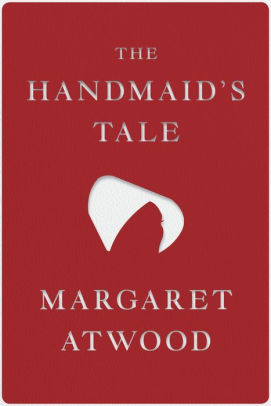
This 1998 cover is quite traditional in its approach to the story depicting a quite an innocuous scene from the book of a couple of handmaids in front of ‘The Wall’ but doesn’t really give you any more of an inkling into the novel’s contents. It is an expressive cover which seems to be aimed at older readers in its use of imagery and serif fonts used. It is printed in full colour which gives the book a more expensive feel and looks but is still wildly different from the Picasso-esque first edition cover from 1985.
First edition 1985 Jacket design by Tad Aronowicz. Illustration by Gail Geltner
1998 saw the Royal Assent of the Human Rights Act which was in complete contradiction to the book in which women have no rights at all in a dystopian society. This was also right in the middle of the ‘girl power’ era which helped with the sales of the novel. The cold war was also coming to an end and the wall holds some symbolism towards this.
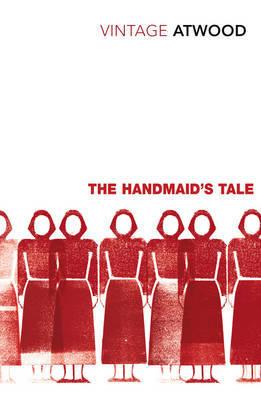
2010 – This Australian cover is a 2 colour cover which looks like the image has been overprinted and is reminiscent of propaganda posters and has a utilitarian look. All the figures are the same without features which I feel represents the suppression and lack of identity of women in the book. It feels very minimal and bleak which reflects the time with the global financial crisis being at the forefront of everyone’s mind.
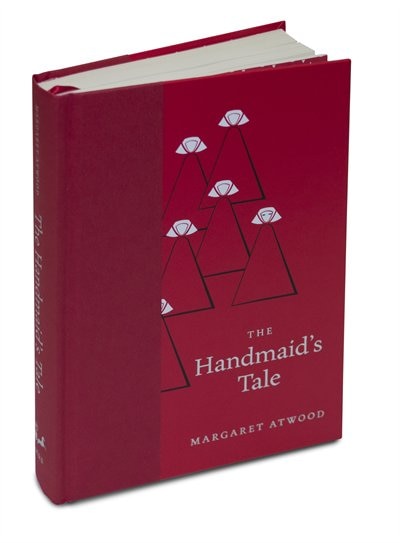
2016 – A more decorative cover with elements of the story interwoven with flowers that include bleeding hearts and lilies that are symbolic of sorrow, unrequited love and death.
2017 – Another ‘red’ book cover, this time depicting stylised handmaids all identical except one which has facial features showing the rebelliousness of the main character and her unwillingness to conform.
2017 – This cover is based on the TV series and is aimed at new readers who have watched the series. Again red, white and black are used, this time in conjunction with a photographic image.
2019 – I have included this one as on this cover the typography takes centre stage and there is minimal imagery. This gives very little away about the novel and has also split the word ‘handmaid’ to make the type work.
2019 – There were several new covers for this novel following the success of the TV series. This one caught my eye as it reminded me of older-style, pocket novels from the early days of mass-printing with its serif type and muted red colour.
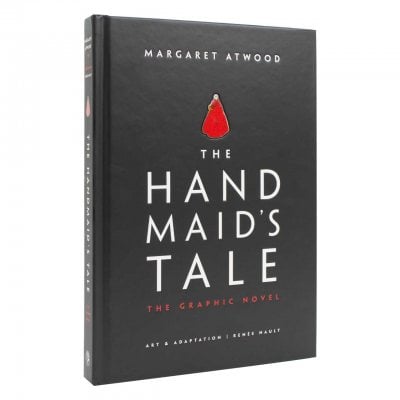
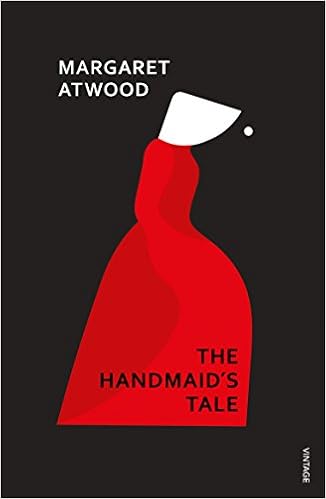
2019 – My wife has a copy of this version which I really like. The simplicity of the imagery reversed out of the black background in vibrant red and white is now synonymous with the novel and is easily recognisable.
2020 – This new cover for the Penguin Classics range is a lot more illustrative depicting the beauty within the handmaid with the use of the flowers, while still keeping the red and white uniform and the wall in the background.
2021 – Again a Penguin cover due for release next year depicting a handmaid from above and her shadow is cast in the shape of a keyhole symbolising her imprisonment with the wall beyond. This is a conceptual cover that isn’t as literal as some of the others I have seen. I like the simplicity and the bleak feeling it portrays.
Recurring Motifs
Red/white/black colour scheme
Uniforms/hoods
The wall/brickwork
Faceless/lacking identity
For my designs, I decided to use mainly the uniform and the red, white and black colour scheme. The idea of the wall also snuck in there too.
The handmaid’s hood/hat was an interesting shape that I wanted to use, so this became my main element for my designs.
I set up some artboards and started by designing the shape of the hood/hat. I then tried as many iterations as I could using this as either the focal point of the design, the basis for a pattern and using it as a type element. I also tried just using the colours to represent the uniform abstractly while trying to use some of the influences I had come across in the last exercise I ended up with 12 covers that I liked which I then asked my peers for their opinions on them. I was surprised at their varied tastes and the different preferences that they had. This illustrated to me why books can have several different cover designs to appeal to different audiences and markets.
Reflection
It was nice to get back to designing after a research-heavy section.
This was an interesting exercise in that it showed the evolution of a single book’s cover over the last 35 years and what may have influenced the designs and how styles and tastes have changed. As mentioned above, the feedback I received on my designs gave me an insight into different people’s tastes and how books have different covers depending on their audience. It has given me things to bear in mind when designing books in the future.
The kind of stock you choose will be informed by the nature of the job you’re doing. If you were working commercially, then checking paper quality – the weight and finish of the paper – is something you would do with your client, as paper choices can add both quality and cost to a design job. The advent of high-quality digital printing in almost every high street has made high finished standards much more achievable and affordable – although you might be amazed at what can be achieved with a photocopier and coloured 80gsm paper!
Knowing what papers are available and their qualities is an important part of what you might offer as a commercial book designer. One way to do this is by requesting sample books from commercial paper merchants or talking to your local printers, who can give you a swatch of the papers they recommend for you to share with your client and keep for future reference. Another way of doing this is by looking at as many different kinds of books as you can and critically start to gauge the weight, grain and finish of the papers. Do all books keep the same paper choices throughout? What’s the relationship between the covers and the paper inside? Which books do you like the feel of, and why?
Analyse the binding style of the books you’ve collected. How does the book block adhere to the cover? How does it adhere to the spine? Is it stitched or glued? You’ll notice that in case-bound or hardback books, the sections, or signatures, are sewn together and glued to the spine. Paperback books, on the other hand, are more likely to be ’perfect-bound’, where the pages are glued together and then directly onto the covering.
Analysis
The Body, a guide for occupants – Bill Bryson
This book block isn’t actually attached to the spine, it is held in place by the endpapers/hinge. There is a small gap between the book block and the spine. The pages are stitched together and have a dark blue headband to match the endpapers of the book. I believe this is known as being ‘case-bound’.
Modernist Cuisine: The Art and Science of Cooking – Maxime Bilet, Nathan Myhrvold, Chris Young
This set of books contained 2 different binding styles. The main 5 volumes are bound in a similar way to the Bill Bryson book above with the addition of a ribbon sewn into the headband to be used as a bookmark. The stitching is a lot more visible in these books, this could be down to the paper quality and high value of the books. The Kitchen Manual volume is spiral bound allowing it to be laid flat while being used so that it doesn’t need to be held or the reader doesn’t have to worry about the pages turning over mid-recipe. The pages are all individual(no signatures) which also assists in the book being laid flat.
Do Androids Dream of Electric Sheep? – Philip K Dick
This book is ‘perfect bound’ meaning that it is not stitched together. They are glued together which is a much cheaper and faster way of producing books. The pages are glued onto a strip which is then glued into the cover. They are glued flush to the cover which does not extend beyond the book, unlike hardcovers.
Gigantosaurus – Jonny Duddle
This children’s book has its signatures stitched together. These are then glued into the cover. The book block is glued down the spine and hinge. The hinge is around 80mm and helps hold the book block in place.
The Ipplepen Magazine
This publication is ‘saddle-wire stitched’ which is another term for stapling. This is a cheap and easy way to bind pages together for small publications such as pamphlets, booklets and zines.
David Copperfield – Charles Dickens
This book has its signatures stitched together but has no headband. The book block is attached to the cover by the endpapers. Even though this was meant to be a cheap book that was available for all who could afford the price the binding wasn’t really scrimped on at the time and the paperback book wouldn’t be developed for another 28 years. This book is very delicate now and the binding is beginning to fail, but it is 123 years old and I don’t see many paperbacks being in such good condition after as many years.
Reflection
Before this exercise, I hadn’t looked at how different books were bound in much detail. I now find myself looking at all the books I pick up and looking to see if you can see the signatures, the stitching or whether the book is case-bound or perfect bound. This exercise has also given me an insight into the book-binders art, especially the copy of David Copperfield from 1907. My appreciation of books is growing with each exercise.








 craig519809.home.blog
