Assignment 5: Photography is simple

‘There are two fundamentals in all picture taking – where to stand and when to release the shutter … so photography is very simple.’

(Jay & Hurn, 2001, p.37)

So photography is simply viewpoint and moment… but what about subject? The simplest subject is the moment. You can record the moment with a snapshot, but when you review the photograph later you find you didn’t actually record the moment, you just recorded the ‘event of photography’.

It might take a very long time to simplify the whole world and its infinite framings into a subject that makes sense to you. Robert Adams said, ‘Sooner or later one has to ask of all pictures
what kind of life they promote’ (Grundberg, 1999, p.34). For now, though, you should just feel comfortable with your subject. It should say something about you and, in the end, you like it!

Brief

The final assignment is an open brief. Take a series of 10 photographs of any subject exploring the theme ‘Photography is Simple’. Each photograph should be a unique view; in other words, it should contain some new information, rather than repeat the information of the previous image.

Assignment notes

In your assignment notes explore how you think you’ve answered the brief. This is a chance for a little philosophical reflection. EYV student Tor Burridge:

‘I have reconsidered my stand point that fundamentally photography is simple. When I shoot for the pure enjoyment of it photography does indeed feel simple. But really it is the product of layers of knowledge – on composition, on light, the technicalities of my camera. It is also inevitably influenced by the work of others, the subtle lessons that I have unknowingly committed to memory about angles and viewpoint. So taking into consideration the effects of context, the mind-set of the viewer and also the subtleties of what influences a photographer to make an image in a particular way, I think it can be concluded that photography is simple – until it isn’t.’

Make sure you word process and spellcheck your notes as QWE (the Quality of Written English) is an important part of presentation. Include a ‘Harvard’ bibliography to reference your reading and research for this assignment. The quality of your references and how deeply you’ve responded to them is more important than the quantity.

You may like to request a video tutorial for this assignment. As well as the opportunity to discuss the development and/or resolution of the assignment work, your tutor will be able to answer any questions you may have on assessment and progression to the next unit.

Research

Michele Groskopf

‘Not to sound corny but I go on and on how much street photography has taught me about myself – more than it taught me about people, what it’s taught me about myself. What makes me tick, what I love to look at, what I’m interested in, how resilient I can be, how creative I can be. I wish that for everybody, I wish everybody’s passion led to that kind of self knowledge and self love.’

Michele Groskopf’s Interview with Ibarionex for Candid Frame is at https://audioboom.com/ posts/4242053-tcf-ep-312-michelle-groskopf [accessed 25/01/18]

Miho Kajioka

‘It was Japan’s 2011 earthquake and tsunami that reconnected me to photography. Two months after the disaster, while reporting in the coastal city of Kamaishi, where over 800 people died, I found roses blooming beside a blasted building. That mixture of grace and ruin made me think of a Japanese poem:

In the spring, cherry blossoms, In the summer the cuckoo,
In autumn the moon, and in Winter the snow, clear, cold.

Written by the Zen monk Dogen, the poem describes the fleeting, fragile beauty of the changing seasons. The roses I saw in Kamaishi bloomed simply because it was spring. That beautiful and uncomplicated statement, made by roses in the midst of ruin, impressed me, and returned me to photography.

Miho Kajioka’s series ‘as it is’ is on Lens Culture: https://www.lensculture.com/articles/miho- kajioka-as-it-is [accessed 25/01/18]

Ane Hjort Guttu

‘I was in this state where everything could be art, or not… as if I was inside a zone where all things could be the result of a higher formal awareness: the roads, the chewing gum on the sidewalk, the yellow light over the city on our way home from kindergarten. Or it could not be, it didn`t matter any more. Everything became art, and in that same moment nothing’.

Morgan Quintance’s interview with the Norwegian artist Ane Hjort Guttu is on Soundcloud. Listen out for the slightly uncanny ‘bell’ at 18:52, it marks the beginning of the passage quoted above. The paradox that Guttu is referring to has been visible in art since Duchamp and examples of it appear here in the ‘Equivalents’ by Stieglitz and ‘Gas Stations’ by Ruscha. You experimented with it yourself in Exercise 1.4.

http://www.mixcloud.com/Resonance/studio-visit-12jun2016-ane-hjort-guttu_studio-visit/

[accessed 25/01/18]

Reflection

Check your work against the assessment criteria for this course before you send it to your tutor. Make some notes in your learning log about how well you believe your work meets each criterion.

Reworking your assignment

Following feedback from your tutor, you may wish to rework some of your assignment, especially if you plan to submit your work for formal assessment. Assessors will make an objective evaluation of your work against the assessment criteria through the assignments, tutor reports and learning log, so after receiving your tutor’s comments, review your assignment and write up any changes you make in your learning log.

It is simple…honest!

Photography is a form of non-verbal communication. A meaningful photograph, or a successful photograph does one of several things: It allows the viewer to see something that he or she has looked at many times without really seeing it; It shows something that that he or she has never encountered; or it asks questions, creates mysteries, interest or sparks curiosity. In other words it makes us question what? Photographs can inspire, invoke awe, wonder, amusement, compassion, horror or endless other emotions and feelings. It raises questions about the world around us or educates us about the world around us.

At its best, a photograph conveys a thought from one person, the photographer, to another, the viewer. Photography is therefore similar to other forms of artistic non-verbal communication whether it’s painting, sculpture or music. Each of these forms of art means something to its viewer/listener without them being present when it was created. Whether it is a portrait photograph or an image of a landscape, they all convey more than just the thing that is being depicted, but also they convey the majesty or magnificence felt when viewing the subject first-hand. Even though photography is a relatively new media compared to the more ‘traditional’ arts, it can still tell the whole story and no other media is needed.

The plan

I’d always had a plan for this final assignment since I had completed the first one. I didn’t get chance to explore the 60s/70s telephone exchange in the village in which I live. It is a bit of an eyesore in the thatched cottage, picturesque village and is due to be demolished to make way for a new car park. However, it is and has been an integral part of village life for many years and has served its purpose from the analogue days through to the modern digital age. So, with my new love of photography and new camera in hand, I took the opportunity to go and have a look.

I have just treated myself to a Canon EOS 90d (don’t tell the wife!) with a new 18-135mm lens. I realised that my old 450d was on par with my iPhone in terms of image quality and functionality and it needed a step up. I also wanted a more versatile lens that would enable me to take more variety of images with the one lens instead of having to always carry a multitude of lens sizes with me at all times.

This was the perfect opportunity to try them out.

I wasn’t sure what to expect at the site and wondered if I’d be able to get enough shots for the assignment criteria. Some were easier than others, and some needed a little more post production than others. As a result some images are stronger and more successful than others, but as a group I feel that they tell a story of the building that is there and its utilitarian beauty.

My select

I have selected 10 images of the phone exchange that I think give an idea of its former use and the feel of it being obsolete at the same time.

Canon EOS90d EF-S 18-135mm ISO 100 f/3.5 1/250 sec
Canon EOS90d EF-S 18-135mm ISO 100 f/3.5 1/50 sec
Canon EOS90d EF-S 18-135mm ISO 100 f/4.0 1/80 sec
Canon EOS90d EF-S 18-135mm ISO 100 f/4.0 1/13 sec
Canon EOS90d EF-S 18-135mm ISO 100 f/4.5 1/80 sec
Canon EOS90d EF-S 18-135mm ISO 100 f/4.5 1/5 sec
Canon EOS90d EF-S 18-135mm ISO 100 f/3.5 1/80 sec
Canon EOS90d EF-S 18-135mm ISO 100 f/5 1/80 sec
Canon EOS90d EF-S 18-135mm ISO 100 f/3.5 1/80 sec

Reflection

For this assignment I deliberately used a simple subject to show that even the most mundane of subject matter can be made interesting with a creative eye and a little planning of what it is you are trying to achieve. Photography for fun can be simple point and shoot, whether that’s with a camera or, more commonly these days, a mobile phone. But it also can be complicated and more contrived when viewed through the eyes of a designer or photographer. This is when thoughts of light, composition, shutter speed, and depth of field come into play and the thought process becomes more time consuming and more important than releasing the shutter. In an age of instant gratification and social media, photography is everywhere. However, the idea of it being instant can be a contradiction when it comes to the amount of work needed to get ‘that’ shot.

I feel that through the course of this module I have gained more of an insight into photography and an appreciation of the skill that goes into creating good images. Through the material in this module and my own independent research, I have reignited my interest in photography and I think that this shows through the work produced from my initial submissions to the latter parts of the course.

Assignment 4: Languages of Light

As a distance learning student at OCA you’re not an autodidact, you have the benefit of tutor reports and a formal assessment at the end of each course. One of the ways to make the
most of tutor reports is to rework assignments after receiving feedback. In fact, it’s a good
idea to approach the whole course – exercises, contextual research and assignments – as an ongoing body of work, until you decide you’re ready to enter for assessment. With this in mind, Assignment Four asks you to return to one of the exercises from Part Four and develop it into a formal assignment submission.

You’ll need to submit prints at assessment and sharing with your tutor at this point in the unit will be an opportunity to get feedback on print quality. If you’re hard pressed to submit the prints you don’t have to send the whole assignment, you can send a selection and submit the rest of the series via blog or in the usual way that you’ve agreed with your tutor.

Brief

Revisit one of the exercises on daylight, artificial light or controlled light from Part Four (Ex 4.1, Ex 4.2 or Ex 4.3) and develop it into a formal assignment submission. The submission requirement for this assignment is a set of between six and ten high-quality photographic prints.

There are many ways to edit and the most valuable one is probably to show your work to friends, family and your OCA peers for feedback – you are guaranteed to discover something new in your work. Another tip is to pin the work up on the wall and live with a for a few days. ‘A Quick Guide to Editing Your Photo Series using Stickies’ on the IPO (Invisible Photographer Asia) website, but bear in mind that this is not a narrative assignment – you’re not required to produce a story.

http://invisiblephotographer.asia/2013/11/18/editing101-quickguidestickies/

Assessment of photography in any context is an assessment of images and accompanying words so please Include a written analysis of your work outlining:

  • how you have developed the assignment from the original exercise in Part 4
  • which practitioners you’ve looked at for inspiration and how their work has influenced you
  • your technical approach and any particular techniques you incorporated
  • the strengths and weaknesses of particular photographs and your project as a whole (self-assessment). Conclude your notes with a personal reflection on how you’ve developed the exercise in order to meet the descriptors of the Creativity criteria. Write 500–1,000 words.

Initial idea

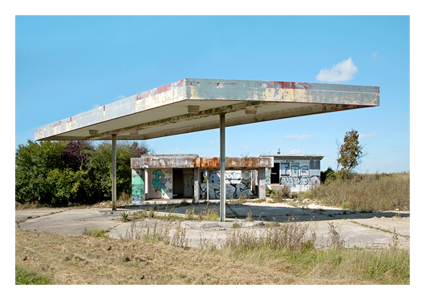
From the images from the previous exercises, the one I was drawn to was the one of the petrol station in the exercise ‘Artificial Light’.

When I took this shot in the original exercise it reminded me of Edward Ruscha’s ‘Twentysix Gasoline Stations’ and the later ‘Twentysix Abandoned Gasoline Stations’ by Éric Tabuchi.

Standard, Amarillo, Texas
Twentysix Abandoned Gasoline Stations

I wondered if I could expand on this idea using artificial light as the the theme for the assignment and base it on the nearby countryside petrol stations. I wanted to take the images at night to show the different light used in the range of ages and uses of the petrol stations. While out taking the my shots, due to the longer shutter speeds, I managed to capture both the stillness of the stations and the movement of the traffic around them.

Canon EOS 450D EF-S 10-18mm ISO 100 f/13 1.3 sec
Canon EOS 450D EF-S 10-18mm ISO 100 f/8 4/5 sec
Canon EOS 450D EF-S 10-18mm ISO 100 f/8 25 sec
Canon EOS 450D EF-S 10-18mm ISO 100 f/8 1/2 sec
Canon EOS 450D EF-S 10-18mm ISO 100 f/13 8 sec
Canon EOS 450D EF-S 10-18mm ISO 100 f/8.0 3/10 sec

I then tried them in monochrome to see if the colour of the light mattered or whether the viewer could still interpret the images without the distinctive light colours.

Some worked better than others, but some of the images didn’t rely on the colour of light mattered to the overall ‘feel’ of the image.

While playing with artificial light it occurred to me that this was the ideal time of year to capture plenty of them while out and about in Totnes on a December evening. I had wanted to experiment with bokeh, and the Christmas lights seemed the obvious way to do that.

Unlike the previous images, these definitely benefit from being full colour. They convey enough information without being in focus, but you can get the general idea in most of the images of what the subject is meant to be.

Select

My ‘select’ for this assignment are the black and white images of the petrol stations. They depict both the ambient light of the stations themselves as well as the movement of the traffic around them with the long exposure of the headlights and break lights. I think that these are more original than the bokeh Christmas lights.

Reflection

This assignment proved to be a challenge when it can to the subject matter. Once I’d honed in on the idea of the petrol stations I was glad to have a direction. However, I then doubted the idea and tried something different but kept coming back to the original concept and I’m glad I did as it gave me the chance to go back to my shots and re-evaluate them and what was important about them and what wasn’t. The important thing was the light itself, not the colour of it, and how it was conveyed. Capturing the light at night had its challenges but also led to some unexpected results which added to the end result. Planning where to go and what to shoot also helped in getting what I wanted. I think that this could be improved upon to help achieve better results. This part of the course has helped me to see and understand that planning is often more important than taking the shots themselves.

References

Adsum. 2021. Ed Ruscha’s Twentysix Gasoline Stations. [online] Available at: <https://adsumnyc.com/blogs/news/twenty-six-gasoline-stations-ed-ruscha&gt; [Accessed 27 December 2021].

2021. [online] Available at: <https://www.lespressesdureel.com/EN/ouvrage.php?id=1783&menu=0&gt; [Accessed 27 December 2021].

Exercise 5.3: Looking at photography

‘When somebody sees something and experiences it – that’s when art happens’

(Hans-Peter Feldman)

If photography is an event then looking at photography should also be an event.
Look again at Henri Cartier-Bresson’s photograph Behind the Gare Saint-Lazare in Part Three. (If you can get to the Victoria & Albert Museum in London you can see an original print
on permanent display in the Photography Gallery.) Is there a single element in the image that you could say is the pivotal ‘point’ to which the eye returns again and again? What information does this ‘point’ contain? Remember that a point is not a shape. It may be a place, or even a ‘discontinuity’ – a gap. The most important thing though is not to try to guess the ‘right answer’ but to make a creative response, to articulate your ‘personal voice’.

Include a short response to Behind the Gare Saint-Lazare in your learning log. You can be as imaginative as you like. In order to contextualise your discussion, you might want to include one or two of your own shots, and you may wish to refer to Rinko Kawauchi’s photograph mentioned above or the Theatres series by Hiroshi Sugimoto discussed in Part Three. Write about 300 words.

Exemplar:

John Adrian Orr: https://johnaorroca.wordpress.com/category/coursework/part-5/
Hans-Peter Feldman: www.youtube.com/watch?v=mPPhiSgv5fw [accessed 25/01/18]

Response

Behind the Gare Saint-Lazare is the most well-known photo by Henri Cartier-Bresson. It is said to be a masterpiece in timing and form. Just using his 35mm camera, all the stars aligned for a split second and he was rewarded with this photo.

The shot of a man jumping/hopping before touching the water looks, at first glance, as a quickly taken snapshot but due to the timing and composition there is a lot more is going on in the photo. Modern cameras make this much easier to capture than what Henri Cartier-Bresson had available to him. A small Leica which enabled faster photos compared to the bigger cameras that needed tripods especially the year it was captured (1932) was still nothing compared to modern DSLR cameras that can take several frames per second. This was a single shot with a film camera.

Composition with the man leaping made stronger by the silhouette against the white background is what stands out at first glance then looking closer you can see a dancer on the poster on the wall with the stance almost echoing each other. What makes the photo even more special is it was basically  captured through a fence, a spontaneous shot that was going to become known as “the decisive moment” with photographers for decades-to-come being inspired. The setting of the train station of Saint-Lazare a perfect place to capture a busy, bustling shot with a hint of luck.

Horizontal and vertical lines are a strong point from the ladder in the foreground to the verticals of the fence and buildings in the background, figures almost standing still while the main subject creates a sense of speed, then the eyes follows a zig-zag pattern from the horizontal fences down to the ladder in then to man jumping, plus the reflection then emphasises the man in motion with the large amount of whitespace around it.

Exercise 5.1: The distance between us

Use your camera as a measuring device. This doesn’t refer to the distance scale on the focus ring. Rather, find a subject that you have an empathy with and take a sequence of shots to ‘explore the distance between you’. Add the sequence to your learning log, indicating which is your ‘select’ – your best shot.

When you review the set to decide upon a ‘select’, don’t evaluate the shots just according to the idea you had when you took the photographs; instead evaluate it by what you discover within the frame (you’ve already done this in Exercise 1.4). In other words, be open to the unexpected. In conversation with the author, the photographer Alexia Clorinda expressed this idea in the following way:

Look critically at the work you did by including what you didn’t mean to do. Include the mistake, or your unconscious, or whatever you want to call it, and analyse it not from the point of view of your intention, but because it is there.

Exemplars:
Andrea Schwickart: https://eyvlog.wordpress.com/2017/08/21/the-distance-between-us- exercise-5-1/

Morris Gallagher: https://morrisgdotorg.wordpress.com/exercises/exercise-5-viewpoint/ exercise-5-1-viewpoint-explore-the-distance-between-you/

Darryl Godfrey: https://darrylgodfrey.wordpress.com/category/coursework/part-5- viewpoint/

The distance…

I was listening to the radio and the discussion was around the similarities between certain creatures and human beings. There was also the fact that humans share 60% of their DNA with bananas!

Banana

However, shots of bananas didn’t inspire me. But we do have a local zoo, and I thought that I could visit there to see some of the monkeys and apes that we are more closely related to.

Chimp

The idea that the apes and monkeys were are closet genetic relatives and yet were so different gave me a starting point for this exercise. There was also the point of them being in captivity, in relation to this exercise, and were there for me to observe and not in the wild which made the distance between us even greater.

Visiting Paignton Zoo in the winter months does however bring more challenges than I thought, from booking a slot due to Covid to half of the zoo being closed for maintenance during the off-season. This meant that the Great Apes (gorillas and orang-utans) weren’t accessible and the majority of the other monkey species were inside keeping warm. So…plan B!

There were still some of the more hardy animals out and about in the zoo, so the distance between myself and my subject might have to be a bit greater than initially thought.

I had a relatively unsuccessful time at the zoo, from the large number of out of focus shots or shots where the shutter speed was too slow, I had managed to get a handful a decent clear shots.

The Maned Wolves were a bit reluctant to come out in the cold!

The most cooperative animals by far were the cheetahs, who seemed to be very curious of what I was up to and this gave me the chance to take some clear shots of them.

Canon EOS 450D 70-300mm ISO 100 f/5.6 1/60 secs
Canon EOS 450D 70-300mm ISO 100 f/4.5 1/125 secs
Canon EOS 450D 70-300mm ISO 100 f/5.6 1/60 secs

Cat
Cats are more like us than you’d think. A 2007 study found that about 90% of the genes in the Abyssinian domestic cat are similar to humans.

My ‘Select’

Of the images of the cheetahs this is my select. The cheetah is looking straight at the camera which begs the question of who is studying who? Am I a curiosity or the next meal? Are we really that different? Does that 10% DNA make a difference? Is the distance that great? How has that made us the dominant species?

References

Business Insider. 2021. Our DNA is 99.9% the same as the person next to us — and we’re surprisingly similar to a lot of other living things. [online] Available at: <https://www.businessinsider.com/comparing-genetic-similarity-between-humans-and-other-things-2016-5?r=US&IR=T#even-bananas-surprisingly-still-share-about-60-of-the-same-dna-as-humans-8&gt; [Accessed 16 December 2021].

Exercise 5.2: Homage

Select an image by any photographer of your choice and take a photograph in response
to it. You can respond in any way you like to the whole image or to just a part of it, but you must make explicit in your notes what it is that you’re responding to. Is it a stylistic device such as John Davies’ high viewpoint, or Chris Steele Perkins’ juxtapositions? Is it an idea, such as the decisive moment? Is it an approach, such as intention – creating a fully authored image rather than discovering the world through the viewfinder?

Add the original photograph together with your response to your learning log. Which of the three types of information discussed by Barrett provides the context in this case? Take your time over writing your response because you’ll submit the relevant part of your learning log as part of Assignment Five.

A photograph inspired by another is called ‘homage’ (pronounced the French or English way). This is not the same as Picasso’s famous statement that ‘good artists borrow, great artists steal’; the point of the homage must be apparent within the photograph. It’s also not the same as ‘appropriation’ which re-contextualises its subject to create something new, often in an ironic or humorous way. Instead, the homage should share some deep empathy or kinship with the original work. An example is Victor Burgin’s series The Office at Night (1986), based on Edward Hopper’s famous painting of the same name:

‘The hackneyed idea of ‘influence’ is not at issue here. I am not interested in the question of what one artist may or may not have taken from another. I am referring to the universally familiar phenomenon of looking at one image and having another image spontaneously come to mind.’

http://www.tate.org.uk/research/publications/tate-papers/separateness-things-victor-burgin

[accessed 25/01/18]

You may already have taken some homage photography where you’ve not tried to hide the original inspiration but rather celebrated it. Refer back to your personal archive and add one or two to your learning log together with a short caption to provide a context for the shot.

Stumble…

While looking at various different photographers for some inspiration for my homage I stumbled upon an image allegedly by Ansel Adams that resonated with me.

The photograph is of a pine tree on Sentinel Rock in Yosemite National Park. It is claimed to be an early work by Adams but this is still to be proven (see the article below).

This image reminded me of the trees that can be seen all across the windswept hills of Dartmoor which is right on my doorstep. I decided to take a trudge across the moor to see what I could do with a similar subject matter. I found a tree atop Elmsworthy Tor, near Haytor, which was suitably windswept and perched on its own on the rocky outcrop.

I then selected a couple of images and tweaked in Lightroom.

Canon EOS 450D EF-S 10-18mm ISO 100 f/8.0 1/800 sec
Canon EOS 450D EF-S 10-18mm ISO 100 f/8.0 1/250 sec

Reflection

I really enjoyed this exercise. I think this has to do with the subject matter resonating with me. As a result I’m very happy with the 2 images I ended up with. Both images are of the same tree, on the same day and yet have 2 completely different feels. The first is stark and dramatic and gives the bleak feel of being up on the moors, and the second shows the colours of the moors which are rich and vibrant even on a windy winter’s day in December. I’m unable to decide which one I prefer as they both have their qualities, but I think the first is more representative of the original image which inspired them.

References

The Independent. 2021. Ansel Adams, the ‘lost negatives’ and a $200m lawsuit. [online] Available at: <https://www.independent.co.uk/news/world/americas/ansel-adams-the-lost-negatives-and-a-200m-lawsuit-2244107.html&gt; [Accessed 16 December 2021].

Exercise 4.4: Personal Voice

Make a Google Images search for ‘landscape’, ‘portrait’, or any ordinary subject such as ‘apple’ or ‘sunset’. Add a screengrab of a representative page to your learning log and note down the similarities you find between the images.

Now take a number of your own photographs of the same subject, paying special attention to the ‘Creativity’ criteria at the end of Part One. You might like to make the subject appear ‘incidental’, for instance by using focus or framing. Or you might begin with the observation of Ernst Haas, or the ‘camera vision’ of Bill Brandt. Or if you’re feeling bold you might forget about your camera completely and think about the tricky question of originality in a different way – http://penelopeumbrico.net/index.php/project/suns/

Add a final image to your learning log, together with a selection of preparatory shots. In your notes describe how your photograph or representation differs from your Google Images source images of the same subject.

For this exercise, as we are looking at light, I chose a lighthouse for my subject matter. The lighthouse in question is the Lizard Point lighthouse in Cornwall.

The images on the Google search threw up lots of images of the actual lens with varying qualities of light, some warm and some cold, some natural and some artificial light, and some in daylight and some in darkness. Quite a lot of them are are taken with a wide-angle or fish-eye lens to emphasise the curvature of the lighthouse itself.

The day of my shots the light was very flat and didn’t lend itself to some interesting colours even refracted in the lighthouse lens. So, in contrast to the majority of the Google images, which were full colour, I decided to use the a framed image of the lens with the sea in the background in black and white and let the contrast of the subject matter to depict the different types of light coming through both the lens and window – the soft, moody sky and the sharp, focussed light of the lens.

Canon EOS 450D EFS 10-18mm ISO 100 17mm f/11 1/50 sec

Exercise 4.3: Egg or Stone

Use a combination of quality, contrast, direction and colour to light an object in order to reveal its form. For this exercise, we recommend that you choose a natural or organic object such as an egg or stone rather than a man-made object. Man-made or cultural artefacts
can be fascinating to light but they’re already authored to some degree, which requires interpretation by the photographer; this exercise is just about controlling the light to reveal form.

You don’t need a studio light for this exercise; a desk lamp or even window light will be fine, although a camera flash that you can use remotely is a useful tool. The only proviso is that you can control the way the light falls on the subject.

Take some time to set up the shot. If you’re shooting an egg, you should think about emptying it first so that it will stand up. This is really a topic for advanced students at Level 3 but you may get some help from Google. The background for your subject will be crucial. For a smallish object, you can tape a large sheet of paper or card to the wall as an ‘infinity curve’ which you can mask off from the main light source by pieces of card. You don’t need to use a curve if you can manage the ‘horizon line’ effectively – the line where the surface meets background. Taking a high viewpoint will make the surface the background, in which case the surface you choose will be important to the shot.

Exposure times will be much longer than you’re used to (unless you’re using flash) and metering and focusing will be challenging. The key to success is to keep it simple. The important thing is to aim for four or five unique shots – either change the viewpoint, the subject or the lighting for each shot.

Add the sequence to your learning log. Draw a simple lighting diagram for each of your shots showing the position of the camera, the subject and the direction of the key light and fill. Don’t labour the diagrams; quick sketches with notes will be just as useful as perfect graphics.

Exemplar: https://ivanradman.wordpress.com/2015/12/15/4-4/

Conch

Canon EOS 450D EF50mm ISO 100 f/8 1/8 sec
Low angle of light from the right hand side
Canon EOS 450D EF50mm ISO 100 f/8 1/30 sec
Light from above and slightly behind
Canon EOS 450D EF50mm ISO 100 f/4 1/20 sec
Low light from behind and to the right
Canon EOS 450D EF50mm ISO 100 f/4 1/40 sec
Light from directly behind

Reflection

This exercise reminded me of the fruit close-ups I had done earlier. This time however, Had more of an understanding of light and how it interacts with the subject and how it can change the look and feel of it. I enjoyed playing around with angles of light and shot which helped me be more decisive with my light positioning and use it in a more playful way.

Exercise 4.2: Artificial Light

Capture ‘the beauty of artificial light’ in a short sequence of shots (‘beauty’ is, of course, a subjective term). The correct white balance setting will be important; this can get tricky – but interesting – if there are mixed light sources of different colour temperatures in the same shot. You can shoot indoors or outside and the light can be ambient or handheld flash.

Add the sequence to your learning log. In your notes try to describe the difference in the quality of light from the daylight shots in Exercise 4.1.

Exemplar:
Claire Daley https://myocafotosnstuff.wordpress.com/2017/03/06/eyv-assignment-4- languages-of-light-images/

Artificial Light

The major advantage of artificial light sources over natural light is that you have them fully under your control. There are many tools for changing their characteristics. Artificial light lets you photograph topics that would be impossible to handle under natural light.

The artificial light sources typically used in photography are constant lights (lamps, daytime permanent photographic lights, hand lamps, etc.) and flashes (studio flash generators and flash guns). Taking pictures with a constant light source is similar to taking pictures with natural light; the main difference lies in the fact that you have many more ways to influence the characteristics of that light.

Taking pictures with flashes works differently than taking pictures with a constant light source. Flashes let you produce several effects that you can’t achieve in constant light. Above all there’s the ability to “freeze” motion and to create various motion studies with help from a flash’s strobe mode.

The Characteristics of Artificial Light

While your options for influencing natural light’s properties are very limited and to a large degree you just have to adapt to the light, for artificial light sources, there are almost endless ways to affect its properties.

Light Intensity

For artificial light, you have two basic paths for how to adjust the intensity of the artificial light source directly:

  • Setting Light Intensity
  • The Light’s Distance

The first path is to set the light’s intensity right at its source. For permanent sources, you can do this for example by choosing the outputs of the bulbs, and for studio flashes and flash guns, by directly choosing their output.

The other way to influence light intensity is through your choice of how far the light is from the scene.

Light Quality

Light quality entirely depends on the relative size of your light source. When using artificial light sources, you have many ways available to control this relative size. The light source itself has a certain absolute size, a light bulb would be a very small light source in a given situation, a large LED panel would be a large light source in that same situation.

Light Color

The color of a flash is usually balanced to match daylight. Among permanent lights, you’ll encounter classical incandescents with their warm (orange) hue, and fluorescents (with a green hue). But today ordinary fluorescents and compact fluorescents are both available in daylight versions. Modern LED panels are also balanced for daylight.

Light Direction

While sunlight’s direction depends on the time of the year and day, for an artificial light source, you can choose its direction precisely to fit your photographic goals.

Night Photography

Taking photos at night might seem counterintuitive to most people, because at first glance… there’s not much to see. Photography is a form of art with light as its foundation – whether it’s film or digital, light is needed to create a photograph. Artificial light provides us with a source of light that’s adjustable and diverse in its applications. Finding artificial light is easy for those who live in large urban areas, but for those who live more rurally artificial light is less abundant.

Out and about…

I went for a wander after dark with my camera and my trusty 50mm lens to get some shots of how artificial light is used to highlight the night and how it is used for the mundane things that we take for granted whether it was the cold utilitarian lighting or the more inviting, warmer light used to welcome visitors.

Canon EOS 450D EF 50mm/f1.8 ISO 1600 f/11 1/10 sec
Canon EOS 450D EF 50mm/f1.8 ISO 1600 f/1.8 1/40 sec
Canon EOS 450D EF 50mm/f1.8 ISO 1600 f/1.8 1/15 sec
Canon EOS 450D EF 50mm/f1.8 ISO 1600 f/11 1/8 sec
Canon EOS 450D EF 50mm/f1.8 ISO 1600 f/11 1/5 sec
Canon EOS 450D EF 50mm/f1.8 ISO 1600 f/1.8 1/15 sec
Canon EOS 450D EF 50mm/f1.8 ISO 1600 f/11 1/8 sec

Reflection

Artificial light is a lot easier to control than natural light. Depending on the type of light used dictates the feel of the image. Whether it’s flat or directional; warm or cold; coming from a single source or multiple angles, light can affect the feel and tone of an image.

With my images I was only using a hand held camera with the ISO cranked right up to compensate for the shutter speed needed. In future, if I need more night shots, I will use a tripod and longer exposure times so that the ISO can be reduced and image clarity can be improved. However, the grainy look of some of the shots give them a retro street photography vibe.

Exercise 4.1: Daylight

Taking the photography of Mann, Atget or Schmidt or a photographer of your own choosing as your starting point, shoot a number of photographs exploring the quality of natural light. The exercise should be done in manual mode and the important thing is to observe the light, not just photograph it. In your learning log, and using the descriptions above as your starting point, try to describe the quality of the light in your photographs in own words.

Research

In the book ‘The Art of Photography’ light is described as the ‘central issue’ of photography. The term photography was first coined in 1839 by William Henry Fox Talbot and was an amalgamation of the Greek words ‘photo’ meaning light, and ‘graphy’ meaning to draw. Therefore photography was viewed as ‘drawing with light’.

Outdoor lighting, sunny weather provides directional light, as do dawn and dusk (The Golden Hour) light from the East or West. However, there is a difference between sunlight and dawn or dusk light, both are devoid of the deep shadows associated with sunlight. Overcast light provides flat, non-directional light. But some cloud cover can provide enough directional light to give some shadow depth. When photographing in daylight it is worth assessing the current lighting conditions versus other possibilities in order to envisage the same situation under alternate conditions.

I googled all three of the artsists mentioned above to see which images stood out. By doing this, I was drawn towards Eugène Atget, as his work contains a variety of approaches as mentioned in the EYV coursebook; ‘He usually made such images – see, for example, Environs, Amiens – in the middle of the day, when shadows were minimal. Atget’s late photographs, however, are frequently marked by subjective light and deep shadows’.

Atget was a French photographer who is well known for his imagery of the architecture and streets within Paris. Keeping the idea of outdoor photography in mind, I took the opportunity to complete the exercise while out walking the dog around the woods using my 50mm lens as the dog wouldn’t hang around while I set up a shot! Atget’s works included nature and trees and the image I was particularly drawn to was the one below.

Saint-Cloud, Tree Roots, Saint Cloud Park (Atget, 1906)

Atget used a lot of diffused light, in turn capturing a clear and detailed composition. He also made some shots that included heavy shadows or highlights to provide depth and show silhouettes of the surroundings or subjects. I liked the idea of the exaggerated depth of his photos and tried to emulate it in mine.

The following photos were taken on probably the last sunny day of autumn when the light was still warm but the sun was low in the sky with the camera set to manual.

Canon EOS 450D EF50mm f/1.8 f/3.5 1/80 ISO 400
Canon EOS 450D EF50mm f/1.8 f/3.5 1/640 ISO 400
Canon EOS 450D EF50mm f/1.8 f/3.5 1/250 ISO 400
Canon EOS 450D EF50mm f/1.8 f/3.5 1/4000 ISO 400
Canon EOS 450D EF50mm f/1.8 f/3.5 1/800 ISO 400
Canon EOS 450D EF50mm f/1.8 f/3.5 1/200 ISO 400
Canon EOS 450D EF50mm f/1.8 f/3.5 1/40 ISO 400
Canon EOS 450D EF50mm f/1.8 f/3.5 1/4000 ISO 400
Canon EOS 450D EF50mm f/1.8 f/3.5 1/200 ISO 400
Canon EOS 450D EF50mm f/1.8 f/3.5 1/125 ISO 400

Reflection

  • Natural Light has colour depending on the time of the day-warm at sunrise/sunset, blue during the day, neutral in the absence of sun or when overcast
  • Light can be used to convey an atmosphere or emotion
  • One can creatively change the mood of photograph depending on the exposure combination of iso, aperture and shutter speed
  • Over-cast days or when the light is neutral is best for recording and documenting a scene i.e. doesn’t have mood or emotion to detract from the scene
  • Different types of light add to the creative pallet of a photgrapherer
  • Properties of light include, quantity, quality, direction, reflection/refraction.

References

The J. Paul Getty in Los Angeles. 2021. Saint-Cloud, Tree Roots, Saint Cloud Park (Getty Museum). [online] Available at: <https://www.getty.edu/art/collection/objects/63460/eugene-atget-saint-cloud-tree-roots-saint-cloud-park-french-negative-1906-print-1920s/&gt; [Accessed 14 October 2021].

Barnbaum, B., n.d. The art of photography.

Assignment 3: The (in)decisive moment

‘The decisive moment is not a dramatic climax but a visual one: the result is not a story but a picture.’ (Swarkowski, 2007, p.5)

‘You know it’s funny. You come to someplace new, and everything looks just the same.’ (Eddie in Stranger Than Paradise, Dir. Jim Jarmusch, 1984)

Brief

Create a set of between six and ten finished images on the theme of the decisive moment. You may choose to create imagery that supports the tradition of the ‘decisive moment’ or you may choose to question or invert the concept by presenting a series of ‘indecisive’ moments. Your aim isn’t to tell a story, but in order to work naturally as a series there should be a linking theme, whether it’s a location, event or particular period of time.

Include a written introduction to your work of between 500 and 1000 words outlining your initial ideas and subsequent development. You’ll need to contextualise your response with photographers that you’ve looked at, and don’t forget to reference the reading that you’ve done.

Exemplars

The OCA photography forum is a useful place to discuss ideas, share work and gather informal advice for this assignment.

Tutor Clive White: ‘As ever it’s not about showing us decisive moments it’s about the student showing us they understand the concept and can employ it creatively as a strategy in progressing their own work.’

For a view from assessment read the post on David Fletcher’s Assignment 3 on the WeAreOCA blog here:
https://weareoca.com/subject/film/david-fletcher/

OCA student Steve Young used juxtaposition and ambiguity as his creative strategy (be aware that the brief has since been updated): https://createatocalevel1photograph.wordpress.com/category/assignments/assignment-3/

And another ‘inversion’ of the decisive moment from student Martyn Rainbird: https://ocamartynrainbird.wordpress.com/category/assignments/assignment-3/

Reflection

Check your work against the assessment criteria for this course before you send it to your
tutor. Make some notes in your learning log about how well you believe your work meets each criterion. Your tutor may take a while to get back to you so carry on with the course while you’re waiting.

Reworking your assignment

Following feedback from your tutor, you may wish to rework some of your assignment, especially if you plan to submit your work for formal assessment. If you do this, make sure you reflect on what you’ve done and why in your learning log.

Research

Having previously looked at the original “decisive moment” by Henri Cartier Bresson, I still wasn’t 100 percent clear on the concept and need to clarify it for myself.

I found an article in Inspired Eye Photography Magazine that helped me understand the concept a bit better. The original Idea attributed to Cartier Bresson actually comes from the 17th century writings of Cardinal de Retz when he penned “Il n’y a rien dans ce monde qui n’ait un moment decisif”–“There is nothing in this world that doesn’t have a decisive moment”. This basically translates to those “sliding door” moments in life, whether big or small. The article uses the example of the assassination of Arch Duke Ferdinand in Austria as a major decisive moment in history as it started the First World War.

decisive moment1

This image helped me to understand the concept further as it encapsulated the elements of what makes the decisive moment in photography. It depicts the idea that when the photographer’s eye, heart and mind are in alignment, you stand a good chance of achieving that decisive moment.

However, there is another element to this equation: time.

The ancient Greeks had two words for time: chronos and kairos. The former refers to chronological or sequential time, while the latter signifies a proper or opportune time for action. The Greeks believed that Kairos could be easily caught by the hair when he’s running towards you. But once he would get passed you, you could not catch him by the hair because he is bald from the back. Hence, a Kairos moment, once lost is lost forever….just like the Decisive moment.

It then occurred to me that the ‘Decisive moment’ is also very subjective. One person’s ‘moment’ could be perceived completely differently by another. Just as every ‘moment’ is different, the perception of it is also unique. This then means that it could be applied to any form of photography, whether it is portrait, landscape or street photography. It all depends on when the photographer decides to press the shutter, or not as the case may be to freeze that ‘moment’ in time.

The ideas behind capturing the decisive moment extends well past just street photography and portraiture. Landscape, nature, and travel photography also lend themselves well to a consideration of the decisive moment. The rapid movement of birds or other animals requires a quick shot and a sense of timing. The constantly-changing light of a sunrise or sunset demands an eye for detail and patience to wait out the best moment. Rather than shooting a rapid burst of shots and hoping for the best, you need to plan, anticipate, and photograph only the moment you truly want.

Does this then negate the spontaneous nature of the ‘decisive moment’? Can it be planned or staged?

In his book ‘The Photographer’s Eye’, Michael Freeman goes on the expand on this saying that anticipation is also a vital element of the ‘Decisive Moment’. He suggests, “Take, for example, a scene in front of which someone is about to pass. Before this happens, the composition that suggests itself is likely to be different from the one including the person. Anticipating the changed dynamic is always vital.”

So, if you compose a scene and anticipate something or someone changing that scene is it spontaneous, decisive? Or is it planned, indecisive?

In an article on photographic psychology; John Suler PhD professor of Rider University described the decisive moment as a ‘highly debated concept’. Throughout the years, Cartier-Bresson’s theory has been discussed from various angles and perspectives. Many of the arguments are objectively recent and mainly refer to the growing technological advance.

In his article John Suler, mentions the fact that some modern photographers rejecting the decisive moment as an ‘outdated idea’. This conveys the most discussed contemporary aspect of Cartier-Bresson’s idea – the technology. Photographers in today’s society do not think about the decisive moment anymore, they simply do not have to. New equipment such as cameras are easily capable of capturing enormous amounts of images in incredibly short periods of time. Without the concern, neither the cost nor the necessity to change, acquire new film roll or even then the requirement to develop the shots. Photographers either professional or amateur are able to pick the decisive moment afterwards rather then consider it just before the shot or while taking the photo.

Initial ideas

My initial idea was to use water as my subject matter as I would be able to use both short and long exposure to freeze its motion.

I treated myself to an ND filter to help with the long exposure shots in the daylight. I went straight for an ND10 to start with without knowing it would be too dark to get the desired effect. I did however manage to get one decent shot that had nothing to do with what I was attempting:

Canon 450D EF-S10-18mm f/4.5-5.6 IS STM ISO 100 30 secs f/22

This wasn’t going to as easy as I thought. I dismissed the idea of using water and went back to the drawing board. I felt stuck! I didn’t understand what was being asked of me…

I went back to Cartier Bresson and found a video on YouTube about trying to emulate his work.

This video gave me an insight into what I could do. I’d have to be more spontaneous, I’d need more of a street photography kind of approach. Using some direction from the video I spent a couple of days exploring the coastal towns of Torquay and Dartmouth. I wanted to capture the essence of the English seaside out of season, the juxtaposition of being in a tourist destination when there aren’t any tourists. Another thing I took from the video were the camera settings preferred by Cartier-Bresson and I tried to stick to them and use just my 50mm lens, a shutter speed of 1/125 and an ISO of 400. I also had to be braver and be more spontaneous.

Contact Sheets

Of the 295 shots I whittled it down to about a dozen possibilities. I had already decided that I wanted my images to be in black and white as per Cartier-Bresson. This would also help to link the images as a series.

Canon EOS 450D EF50mm f/1.8 1/125 sec f/1.8 ISO 400
Canon EOS 450D EF50mm f/1.8 1/125 sec f/22 ISO 400
Canon EOS 450D EF50mm f/1.8 1/125 sec f/2.5 ISO 400
Canon EOS 450D EF50mm f/1.8 1/125 sec f/22 ISO 400
Canon EOS 450D EF50mm f/1.8 1/125 sec f/8 ISO 400
Canon EOS 450D EF50mm f/1.8 1/125 sec f/2.2 ISO 400
Canon EOS 450D EF50mm f/1.8 1/125 sec f/7.1 ISO 400
Canon EOS 450D EF50mm f/1.8 1/125 sec f/11 ISO 400
Canon EOS 450D EF50mm f/1.8 1/125 sec f/14 ISO 400
Canon EOS 450D EF50mm f/1.8 1/125 sec f/18 ISO 400
Canon EOS 450D EF50mm f/1.8 1/125 sec f/6.3 ISO 400

Some of these shots were more successful than others, so more culling was needed.

I was happy with the images that I was left with. They were an eclectic mix of the continuing life of out-of-season resorts with a hint of the desolation that occurs when the season ends. Torquay is a lot more seasonal than Dartmouth, as life in Dartmouth revolves around the river and port which never really stops and there is a lot of maritime history there.

Of the images have chosen for this assignment I feel that there is one clear winner when you link it back to to the title and subject – The Decisive Moment:

This image to me is a moment captured in time. When you consider that the train is moving and I was moving the camera to keep up, this shot captures some great lines from the bridge’s shadow which seems to continue the lines of the bridge itself, to the figure silhouetted on the train which are both fortuitous and completely random in nature. I am very happy with this shot.

Reflection

I struggled with this assignment. The brief was open-ended and I think that was what I found most difficult. However, once I set aside any preconceived ideas I had about the idea of ‘The Decisive Moment’ and just went out with my camera and just started shooting. This assignment helped me understand better the essence of the course-‘expressing your vision’ and the different strategies that underpin photographic practice. Cartier-Bresson is a titan among the reference of photographic practice, and it almost felt blasphemous to not try and honour the tradition of the decisive moment. As I dug deeper into it, I found his approach so ubiquitous and imitated, that I wanted to avoid cliche and felt looking for moments ‘pregnant with meaning’ and ‘precise organisation of forms’ somewhat restrictive. However, I did want to play with, interpret, and experiment with the concept, and the journey from my first thoughts to what I ended up with, taught me that the creative process is something you have to be open to – something Cartier-Bresson talks about in the video Lamour de court, and I found this very stimulating.

I feel I have demonstrated decent technical and visual skills, from processing to black and white and general composition, layout, and curation. I used and analysed my contact sheets extensively for this assignment and it helped me decide whether to present the photos in colour or black and white. I found this a difficult decision as I felt some photos worked quite well in colour, others in monochrome. In the end, I went for black and white to achieve more consistency.

Having gone through his process and creating a series from conception through to taking the photographs, curation, and spontaneity have taught me a couple of things. First was, although I respect Cartier Bresson, I find the idea of the Decisive Moment too restrictive creatively and don’t fully agree with the quote from the introduction of the book ‘The Decisive Moment’ that ‘Photography is the simultaneous recognition, in a fraction of a second, of the significance of an event as well as of a precise organisation of forms which give that event its proper expression.’. Events have many ‘moments’ to capture, and no matter how you capture them, whether planned or spontaneous, all results are valid.
The second learning was the workflow and creative process-I loved the fact that when I went out with my camera I had no idea what I might come back with or how an idea might develop and grow.

References

INSPIRED EYE. 2021. How to understand the Decisive Moment. [online] Available at: <https://www.theinspiredeye.net/street-photography-tips/decisive-moment/&gt; [Accessed 20 September 2021].

En.wikipedia.org. 2021. Kairos – Wikipedia. [online] Available at: <https://en.wikipedia.org/wiki/Kairos&gt; [Accessed 20 September 2021].

Freeman, M., n.d. Michael Freeman’s the photographer’s eye.

Youtube.com. 2021. [online] Available at: <https://www.youtube.com/watch?v=OD4hCqORK60&gt; [Accessed 17 October 2021].

Ukessays.com. 2021. The decisive moment. [online] Available at: <https://www.ukessays.com/essays/photography/the-decisive-moment.php&gt; [Accessed 18 October 2021].