

In our earliest years we know a patch of ground in a detail we will never know anywhere again – site of discovery and putting names to things – people and places – working with difference and similitude – favourite places, places to avoid – neighbours and their habits, gestures and stories – textures, smells – also of play, imagination, experiment – finding the best location for doing things – creating worlds under our own control, fantasy landscapes. (Professor Mike Pearson)
Photographers and artists have always found inspiration in their immediate location. There is a concept within Welsh culture called Y Filltir Sgwar (The Square Mile), described above by Professor Mike Pearson. It is the intimate connection between people and their childhood ‘home’ surroundings. Use this ‘sense of place’ as the starting point for your first assignment.
Brief
Make a series of six to twelve photographs in response to the concept of ‘The Square Mile’. Use this as an opportunity to take a fresh and experimental look at your surroundings. You may wish to re-trace places you know very well, examining how they might have changed; or, particularly if you’re in a new environment, you may wish to use photography to explore your new surroundings and meet some of the people around you.
You may wish to explore the concept of Y Filltir Sgwar further, or you may deviate from this. You may want to focus on architecture and landscape, or you may prefer to photograph the people who you think have an interesting connection to the square mile within which you currently find yourself. You’ll need to shoot many more than 12 photographs from which to make your final edit. You should try to make your final set of photographs ‘sit’ together as a series. Don’t necessarily think about making a number of individual pictures, but rather a set of photographs that complement one another and collectively communicate your idea. You may wish to title your photographs or write short captions if you feel this is appropriate and would benefit the viewer.
Think of this assignment as a way to introduce yourself to your tutor. There’s no ‘right’ or ‘wrong’ way to respond to this brief, as long as you try to push yourself out of your comfort zone in terms of subject matter. Try out new approaches rather than sticking to what you think you’re most successful at.
Research
These are just a few practitioners who have worked within their locality and/or in an autobiographical way. Spend some time looking at their work to help you generate some ideas. Document your research and your initial ideas in your learning log.
- Keith Arnatt: www.tate.org.uk/art/artists/keith-arnatt-666
- Gawain Barnard: http://gawainbarnard.com/
- Tina Barney: www.artic.edu/aic/exhibitions/story/barney.html
- Roni Horn: www.tate.org.uk/whats-on/tate-modern/exhibition/roni-horn-aka-roni-horn/roni- horn-aka-roni-horn-explore-exhibitio-10
- Tom Hunter: www.purdyhicks.com/display.php?aID=10
- Karen Knorr: http://karenknorr.com/photography/belgravia/
- Peter Mansell: www.weareoca.com/photography/peter-mansell/
- Marc Rees: www.r-i-p-e.co.uk/
- Jodi Taylor: www.weareoca.com/photography/photography-and-nostalgia/
Submitting your work
Email or otherwise electronically transfer your photographs to your tutor in the following format: 1500 pixels along the longest edge Adobe (1998) colour profile, RGB jpegs.
Include a digital contact sheet (no more than 36 thumbnails per page) of all the photographs you shot for this assignment. (Read forward to Part Three, Project 1 for how to do this.)
Also send to your tutor a written analysis of your work of no more than 500 words. This should contextualise your project by briefly outlining:
- your first impressions and initial response to the brief, and how your idea(s) developed
- which practitioners you looked at for inspiration and how their work influenced you duringthe project
- your technical approach and any particular techniques you incorporated
- the strengths and weaknesses of particular photographs and your project as a whole (self-assessment)
- any thoughts on how you could develop this project in the future.
This should be either Microsoft Word, a Google Doc or PDF format, under 4 Mb in size.
If you’d prefer to submit a hard copy, you may post prints, no larger than A4, to your tutor together with your contact sheet and written contextual analysis. Make sure your prints are carefully labelled with your name, student number and the assignment number.
It’s important that you try to complete this assignment as soon as possible. Your tutor will
use your assignment to get a rough sense of your current level of technical, analytical and creative skills. Whilst you should commit to the exercise and pursue an idea that interests you, it primarily has a diagnostic purpose so don’t labour it.
Reflection
The later assignments on this course ask you to check your work against the assessment criteria listed in the introduction to this course guide before you send it to your tutor. You’ll get some guidance on how to use the assessment criteria at the end of Part One, but have a go now, if you wish, and make some notes in your learning log about how well you believe your work meets each criterion.
Reworking your assignment
Following feedback from your tutor, you may wish to rework some of your assignment, especially if you plan to submit your work for formal assessment. If you do this, make sure you reflect on what you’ve done and why in your learning log.
Initial thoughts
First step was to dust off my 10 year old Canon EOS 450D. Since buying the camera I hadn’t used the camera to its full potential and thought that this was a waste.
I had enjoyed photography when I did my original graphic design diploma in the early 90s. Back then there were no DSLRs and everything was done in the darkroom. This seemed to be the natural next step.
My initial thoughts when reading the brief were that of ‘how can I do this during lockdown?’. I wouldn’t be able to venture far from the sleepy Devon village where I was based. I felt somewhat hemmed-in when it came to subject matter for my shoot. I needed some inspiration, so I took a look at some of the photographers listed above.
Keith Arnett

Keith Arnett’s ‘Walking the Dog’ series appealed to me because they were just images of various people going about their business just walking their dogs. They showed people from different walks of life all on equal footings because of their love of their four-legged friends.
Gawain Barnard
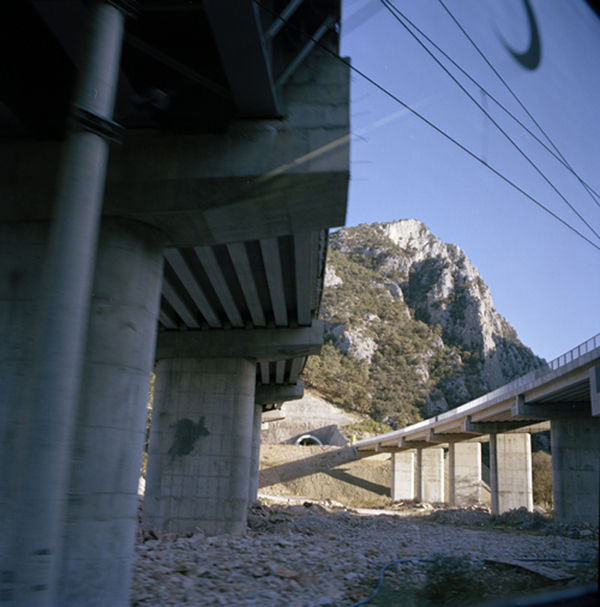
Gawain Barnard’s work ‘Journey’s by Train’ comprise of images taken from a train. Obviously this isn’t possible at the moment, but his images capture architecture and life from the perspective of the passenger.
Karen Knorr

Karen Knorr’s ‘Belgravia’ is a series of ‘non-portraits’ picturing the residents of the London borough. These photographs focus on the people as well as their surroundings during the late 70s.
George Shaw
A fellow student introduced me to the work of George Shaw, who yes is a painter by trade, but his imagery is of the mundane urban landscape of his childhood home of the Tile Hill Estate in Coventry.

Idea
With the country being in lockdown for the third time, my options for locations were limited. The extent of my outdoor antics were limited to the school run to the village school (I’m classed as a key-worker) and going to the Co-op in the village. I started taking my camera on the journey to and from the school and taking detours from the usual route to see what I could see. The village have been inhabited in some form for hundreds of years with earliest records dating back to 952AD and is mentioned in the Doomsday Book. The village is now more of a commuter village for nearby towns and cities but retains its thatched, rural feel.
While taking photographs in and around the village, I seemed to be drawn more to the village’s past rather than what it is now. I found myself concentrating on parts of the village and its surrounds that looked back at its past and what has happen to some of its infrastructure since then.
I deliberately restricted myself to using the one lens for my photos to the standard 18-55mm to see what I could achieve.


Reflection
I initially thought that this was quite a daunting task due to the restriction imposed due to Covid 19. However, once I got my head around what was being asked of me I enjoyed the challenge. The research that I did prior to stating taking photographs helped me to develop an outline of what I could take pictures of, especially the work of George Shaw(even though he’s not a photographer). His pictures of where he lived really helped to inspire me and give me a starting point.
As said above, I deliberately restricted myself to using a single lens to help me re-familiarise myself with my camera and not to over complicate things. This helped me to work with the tools I’d got and try to get the best out of them.
I enjoyed the assignment as a whole, it helped me view my surroundings in a different way. I particularly enjoyed photographing some of the surrounding farm buildings, lyme kilns and the older fixtures and fittings in the village.
The first 2 photographs above are probably my favourites. The colours and the lines in the first photograph give it a very rigid, structured look that I like, that contrasts with the deterioration of the building itself. The second has some good contrast and draws the eye up the path to the old barn. The modernity of the subject of some of the photos didn’t seem to work as well as the more rustic subjects.
I’d like to develop this project further, as the weather curtailed my wanderings. There is still an old 1960/70s telephone exchange in the village that interests me as well as many more country lanes to explore.

 craig519809.home.blog